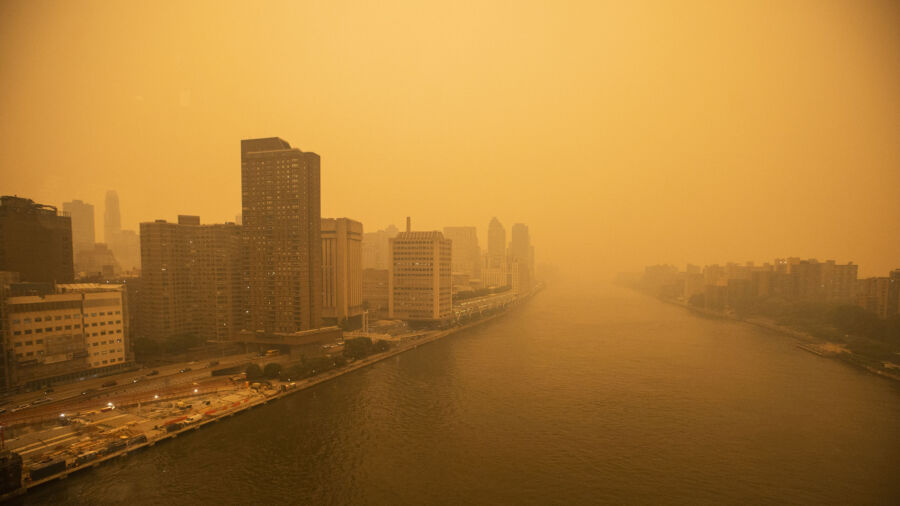
Residents of the northern and northeastern U.S. will see hazy skies for several days amid wildfires in Canada, the National Weather Service New York said on Tuesday.
More than 800 fires are currently burning across Canada, sending a cloud of smoke that will stretch from Minnesota to North Carolina. The smoke recalls the 2023 Canadian fires, when smoke clouded a similar area across the country.
"Smell smoke this morning? Its coming from a wildfire outbreak in Ontario," the National Weather Service
said in a Tuesday social media post. "While it should not impact air quality much today, smoke at the surface could increase Wednesday into Thursday, potentially reducing visibilities and air quality. High temperatures may also be limited."
The post included a video of the forecasted smoke cloud's trajectory.
On Wednesday, the core of the cloud will hang over the northeastern points of Minnesota, Michigan, and Wisconsin, with a less dense cloud stretching across upstate New York, Massachusetts, Connecticut, and Rhode Island, and parts of southern Vermont and New Hampshire.
By Thursday, the smoke will hang over most of Pennsylvania, southern New York, all of New Jersey, and northern Maryland and Delaware.
By the early morning hours Friday, thick smoke will cloud a wide band stretching from the Minnesota-North Dakota border down as far as the Chesapeake Bay. In the daylight hours, smoke will reach Illinois and Indiana, blanket most of Ohio, down into West Virginia, and across the entire Chesapeake region, as far south as North Carolina.
Impact of Smoke on Visibility, Potential Risks to Human Health
The
National Weather Service notes that in the thickest part of the cloud, smoke reaches the surface, slightly reducing visibility and rendering a burnt odor like a campfire. The smoke can also dim the sun and create colorful sunsets.
However, the particulate matter in the air can also create air quality issues for vulnerable groups. The
U.S. Environmental Protection Agency states that particulate matter (PM) is microscopic solids and liquid droplets small enough to be inhaled. Particulate matter less than 2.5 nanometers in diameter—one-thirtieth the size of a human hair—poses the greatest risk to human health.
According to the
Canadian Wildland Fire Information System, there are a total of 823 fires across all 13 provinces and territories. The largest concentration of fires is located in western Ontario near the Minnesota border, and northern Saskatchewan. The country has had 3,431 fires so far this year, which have burned an area of 1,896,754 hectares (nearly 4.7 million acres or 7,323 square miles).
Much of the United States was under a similar blanket of smoke in 2023. A total of
7,207 fires burned that year, consuming 18,528,890 hectares (45.8 million acres, or 71,540 square miles), shattering previous records for the worst fire seasons in the country's history. Thick
clouds of smoke crossed the border into the U.S., covering an area from the Great Lakes to the Great Plains and down the Eastern seaboard as far south as North Carolina.