


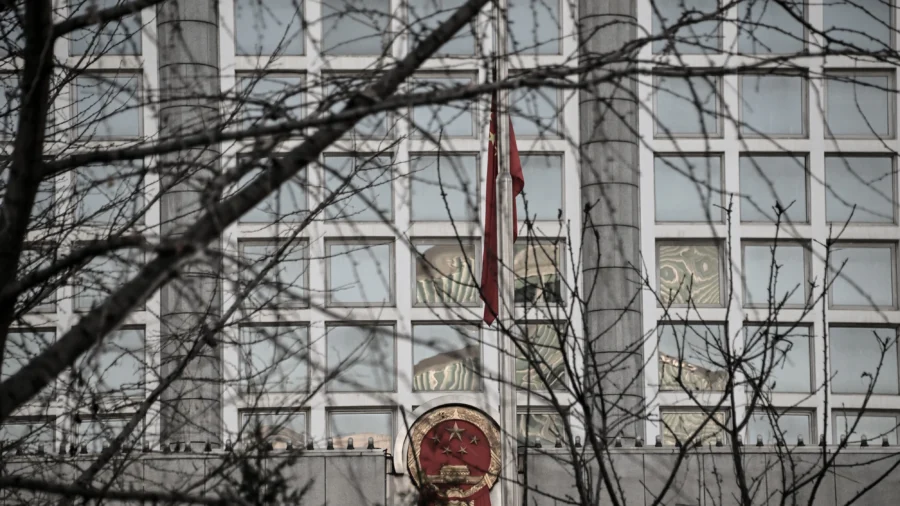
China’s Commerce Ministry announced on Monday new export restrictions on 10 U.S. rare earth and defense companies after the Pentagon flagged several Chinese companies it said were aiding the Chinese military.
The companies targeted by the export controls include rare-earth miners MP Materials Corp. and USA Rare Earth, motor manufacturer Aveox, and defense technology companies Red Cat Holdings and its subsidiary Teal Drones.
Other companies affected are defense technology company IMSAR LLC, ocean technology company Jaia Robotics, spacecraft manufacturer Ball Aerospace & Technologies Corp., military equipment maker Oshkosh Defense, and L3Harris Maritime Services.
The Chinese Commerce Ministry said entities and individuals in any country or region are prohibited from exporting or supplying dual-use items originating from China to those companies, and that “any ongoing related export activities must be immediately ceased.”
In a separate notice, China’s Finance Ministry said it has excluded 46 U.S. companies—including Lockheed Martin Corporation and Raytheon Missiles & Defense—from government procurement activities, effectively prohibiting Chinese government entities from purchasing their goods.
Analysts told The Epoch Times that the measures were Beijing’s latest attempt to respond to recent U.S. restrictions on Chinese military-linked companies, though they differed on how much immediate impact the new Chinese measures would have.
Frank Tian Xie, a professor of marketing at the University of South Carolina Aiken, told The Epoch Times that Beijing’s measures carry both symbolic and practical weight.
Symbolically, Xie said, the Chinese Communist Party (CCP) is trying to show that it can retaliate against the United States and is not backing down in the U.S.–China confrontation.
But the restrictions also have practical significance, he said, because some of the targeted U.S. companies are involved in drones, aerospace equipment, and advanced defense technologies that depend on rare earths and other critical materials whose mining, processing, refining, or supply chains are heavily controlled by China.
“The CCP is still using its control over some rare earth elements, other metal elements, and many supply chains to impose restrictions on the United States,” Xie said.
Xu Zhen, a China affairs and industry-chain analyst, offered a different assessment, saying the restrictions are likely to be more symbolic than practical in the near term.
Xu said the action marked the resumption of U.S.–China economic and trade confrontation after a brief pause following the May summit between U.S. President Donald Trump and Chinese leader Xi Jinping.
He said the Chinese measures correspond to Washington’s expanded list of Chinese military-linked companies.
“This is the CCP’s countermeasure against the United States’ new restrictions expanding the ‘Chinese military companies’ list,” Xu said.
Xu said many of the U.S. companies targeted by Beijing are defense contractors whose main market is in the United States and that they do not depend heavily on the Chinese market.
He said China’s government, financial institutions, and state-owned enterprises have been carrying out large-scale import substitution in recent years because of fears of U.S. infiltration and data leaks.
As a result, Xu said, many U.S. cybersecurity, information technology, and government information-system companies were already unlikely to enter China’s government procurement system.
Pentagon Expands List of Companies
The restrictions came after the Pentagon on June 8 added several Chinese companies—including e-commerce marketplace Alibaba, internet giant Baidu, and electric carmaker BYD—to the list of companies it believes are supporting the Chinese military.The Department of War said in a June 8 release that it had identified 188 entities that meet the statutory requirements for inclusion on the list of “Chinese military companies” operating directly or indirectly in the United States under Section 1260H of the National Defense Authorization Act for fiscal 2021.
The filing was made under the National Defense Authorization Act, which requests the Secretary of War to identify and publish an annual list of Chinese military-linked companies until 2030.
Although the designation serves mainly to alert the public and private sectors to the firms’ national security risks and will not result in immediate sanctions, the move bars the Pentagon from entering into or renewing contracts with them for goods, services, or technology.
It also prevents the Department of War from indirectly procuring from the listed companies through third-party sellers.
On June 10, Rep. John Moolenaar (R-Mich.), chairman of the House Select Committee on the CCP, and Rep. Ben Cline (R-Va.) introduced a bill that would bar employees of Chinese companies included on the Pentagon’s list from entering the United States.
Xie said China’s restrictions could accelerate efforts by the United States and other Western countries to reduce dependence on Chinese-controlled critical minerals and supply chains.
“If it successfully imposes sanctions, U.S. companies will definitely look for substitute products earlier,” he said.
He cited U.S. cooperation with countries such as Japan, Malaysia, Thailand, and Pakistan as part of the broader search for alternative rare earth sources, processing capacity, and supply chains.
If Beijing continues to use its supply-chain position as leverage, Xie said, the result could be faster and deeper economic decoupling.
“The United States and the whole Western world will accelerate the search for alternatives to China and finally get rid of dependence on the CCP,” he said.
Xu also said that both sides are moving toward decoupling, but he drew a distinction between short-term and long-term effects.
“In the short term, they are fighting without breaking [supply chains],” Xu said, referring to the depth of existing industrial-chain ties between the United States and China.
China's Rare Earth Restrictions
China expanded restrictions on rare earth exports last year amid a trade dispute with the United States.In May 2025, the two nations agreed to a 90-day tariff pause, which was later extended to allow time for negotiations. In November 2025, Beijing agreed to suspend the global implementation of its rare earth export controls, according to the White House.
In a May 17 fact sheet, the White House said China would address supply shortages of yttrium, scandium, neodymium, and indium, which are commonly used in smartphones and military technologies.
The Chinese regime also agreed “to address U.S. concerns regarding prohibitions or restrictions on the sale of rare earth production and processing equipment and technologies,” it added.
Xie said the volume of rare earths and other advanced-material exports involved may not be large compared with China’s broader exports, but the materials are critical for defense and high-tech industries.
He said that China still depends more heavily on mass exports of civilian goods, including electric vehicles and solar products, to sustain its economy and maintain market share abroad.
But he said the confrontation over rare earths, aerospace technology, electronics, supercomputing, and artificial intelligence is becoming more intense because those sectors are tied to advanced military and national defense technologies.
U.S. companies operating in China have also reported that export controls, investment restrictions, and China’s expanding counter-sanctions regime are making the business environment more difficult.
The U.S.-China Business Council’s 2026 member survey said around 40 percent of companies reported negative effects from U.S. export-control policies, while China’s expanding export controls and counter-sanctions regime were compounding pressure on American companies.
The same survey said China’s support for domestic companies, including industrial policy and preferential treatment in government procurement is eroding gains from formal market-access openings.