


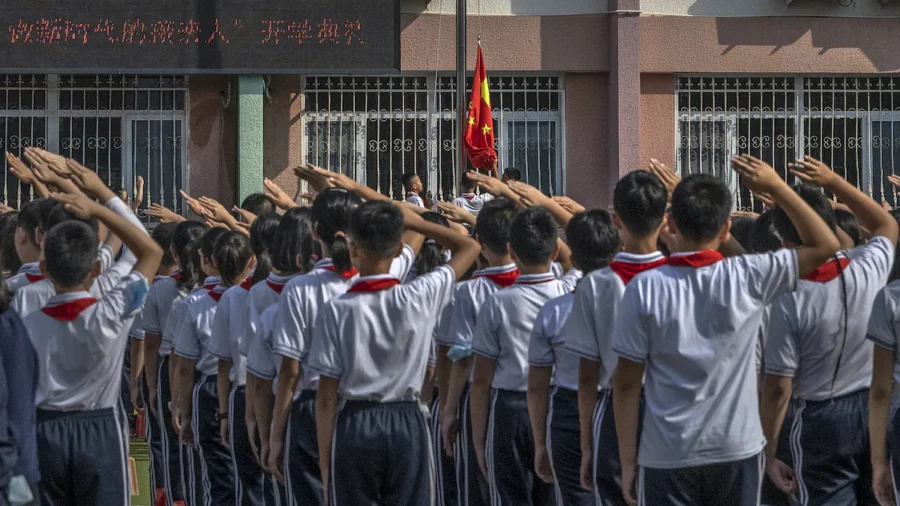
The Chinese Communist Party (CCP) has introduced a new set of so-called national security textbooks for students across the country, embedding political themes such as loyalty to the Party into classrooms.
The four-volume series, titled “National Security Education Readers for Primary and Secondary Students,” has been rolled out nationwide and is intended for use from elementary through high school, according to Chinese state media Xinhua New Agency on April 15. The books were compiled under the direction of the country’s National Textbook Department under the Ministry of Education.
The rollout marks the latest step in the CCP’s broader push to integrate political and ideological education more deeply into China’s school system, extending it to younger age groups.
Political Ideology Introduced Early
Content from the textbooks emphasizes the CCP's role in maintaining national stability and frames national security in explicitly political terms.In the elementary school edition, students are taught that the country’s safety and stability are the result of collective efforts “under the leadership of the Party.”
At the middle school level, lessons stress that “national interests come first.”
High school materials focus on a framework of guiding principles—including adherence to Party leadership over national security and the concept of a “comprehensive national security outlook”—as core components of instruction.
A bookseller in Beijing surnamed Wu told The Epoch Times that the series is being positioned as an “authoritative” resource for national security education and will be used alongside existing political education materials, including textbooks on Xi Jinping Thought, the state ideology and guiding doctrine for the CCP and China.
Some critics say the curriculum reflects an effort to reshape how young people understand the relationship between the state, the Party, and individual rights.
“The core of what the CCP calls ‘national security’ is ultimately political security, meaning the security of the regime itself,” a current affairs analyst from China's Shenyang city told The Epoch Times.
“Teaching elementary school students about Party leadership in this context effectively merges the Party with the state and redefines what ‘security’ means.”
The analyst said the goal of the curriculum is less about educating students and more about encouraging acceptance of existing power structures.
“It is about instilling obedience [to the authorities],” he said, adding that he had chosen to send his own child abroad for education.
Others warn that the approach could have long-term effects on students’ critical thinking.
A retired Chinese middle school teacher surnamed Xue told The Epoch Times that Chinese state media actively promoted the new textbooks in recent weeks. She said that these materials could weaken critical thinking among young people and make them more inclined to accept authority without question.
Part of a Broader Trend
The introduction of the national security textbooks comes amid a wider tightening of ideological oversight in the CCP’s education system.A Chinese scholar surnamed Du told The Epoch Times that the expansion of political education reflects growing concern within the CCP about shaping the attitudes of younger generations.
“Indoctrination is starting earlier and becoming more systematic,” he said, citing anecdotal examples of young children adopting political language at home. “When a system relies on continuous indoctrination to maintain [public] approval, it can also suggest underlying insecurity.”
He noted that efforts to align education closely with state ideology are not without historical precedent—particularly in highly centralized systems—underscoring that schools are being used not only to impart knowledge but also to shape political outlooks from an early age.