


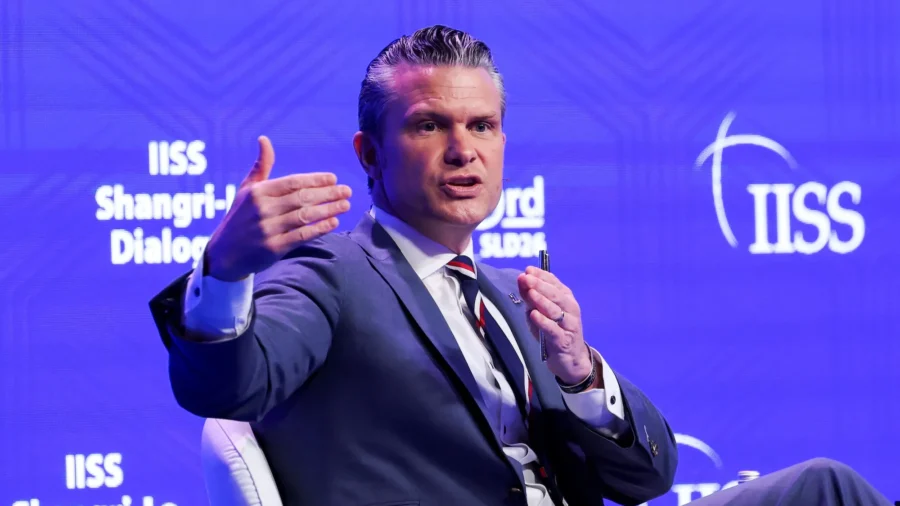
The United States is prepared to resume military strikes against Iran if negotiations fail to produce an agreement, Secretary of War Pete Hegseth said on Saturday, adding that Washington is ready to return to combat even though President Donald Trump prefers a diplomatic solution to end the war.
"Our ability to recommence if necessary ... we are more than capable," Hegseth said during remarks at the Shangri-La Dialogue security conference in Singapore on May 30. The Pentagon chief added that Trump is "patient" and is holding out for a "great deal" that ensures Iran does not obtain nuclear weapons.
Hegseth's comments came as U.S. and Iranian negotiators continued indirect talks aimed at transforming a fragile ceasefire into a broader agreement that could end months of conflict and ease tensions in the Strait of Hormuz, a vital shipping lane for crude oil and other commodities critical to the global economy.
A White House official said after the meeting that Trump would only approve an agreement that satisfies U.S. red lines, including ensuring Iran can never acquire a nuclear weapon.
In a social media post earlier Friday, Trump outlined what he described as key terms of a potential agreement. He said Iran must permanently renounce nuclear weapons, reopen the Strait of Hormuz to unrestricted shipping without tolls, and remove or destroy any remaining naval mines.
"The Hormuz Strait must be immediately open, no tolls, for unrestricted shipping traffic, in both directions," Trump wrote.
Iran Says No Final Understanding Reached
Despite acknowledging that ongoing diplomacy continues, Iranian officials have signaled that significant differences remain.Iranian Foreign Ministry spokesman Esmaeil Baghaei said Friday that Tehran and Washington continue to exchange messages, but no final agreement has been reached.
"We said goodbye to the language of 'must' 47 years ago," Baghaei said in remarks carried by Iran's state-run IRNA news agency, rejecting Trump's public demands.
"None of the Western parties, when speaking about the Islamic Republic of Iran, can use the language of 'must'. We make our own decisions based on the interests and rights of the Iranian nation."
Baghaei said discussions were continuing but "a final understanding has not been reached."
He also criticized the U.S. naval blockade imposed on Iranian ports, calling it illegal and inconsistent with ceasefire arrangements.
Iranian officials have maintained that the current talks are focused primarily on ending the conflict, and discussions about the future of Iran's enriched uranium stockpile should be the subject of a future round of talks.
Meanwhile, the U.S. military continues to pressure Tehran.
On Friday, U.S. Naval Forces Central Command warned commercial shipping that "dangerous military activities" would continue in and around the Strait of Hormuz and cautioned that vessels involved in mine-laying operations could be targeted.
Separate maritime advisories issued through the Joint Maritime Information Center said that the U.S.-led blockade of Iranian ports remains in effect and warned that vessels violating blockade restrictions could face enforcement actions, including disabling or destructive fire.
Iran launched a ballistic missile toward Kuwait on Thursday and carried out drone operations near the Strait of Hormuz, prompting the United States to accuse Tehran of committing an “egregious ceasefire violation” amid fragile negotiations to settle the war diplomatically.
"We're very close, and we're going to keep on working at it," Vance said, while singling out Iran's nuclear program as a challenging issue that may not be easy to resolve.
“There are certain details that are going to have to be figured out,” he said. “Even if you come to an agreement on, let’s say, destroying the enriched stockpile, how do you do it? When do you do it? How do you actually get access to it?”