


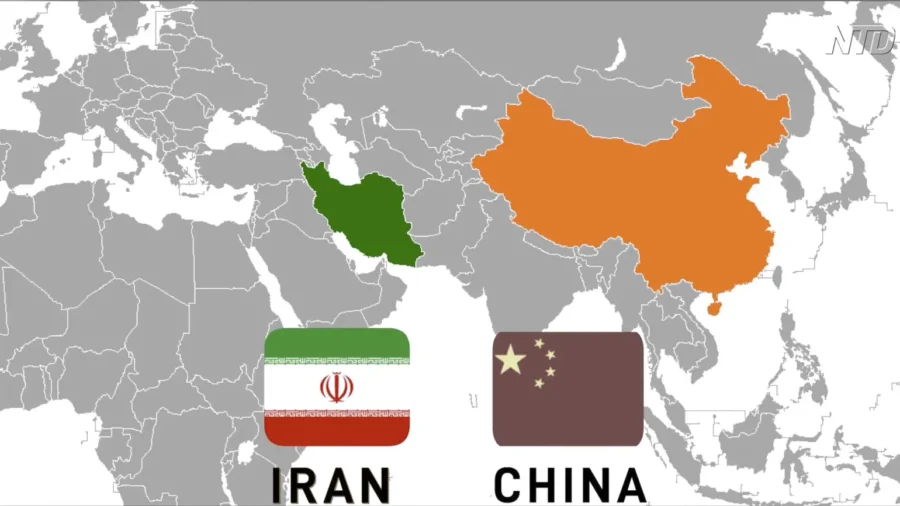
China declined to clearly state whether it would dissuade Iran from blocking the Strait of Hormuz, maintaining strategic ambiguity.
This follows U.S. Secretary of State Marco Rubio's appeal on June 22 for China to urge Iran against blocking the Strait of Hormuz, a critical global shipping lane.
When asked about Rubio’s comment and what role China would play in this situation, Foreign Ministry spokesperson Guo Jiakun sidestepped the question, saying China would “continue playing a constructive role for a deescalation.”
The Strait of Hormuz is the world's busiest oil shipping channel. About 20 percent of global oil and gas flows through this narrow shipping lane in the Gulf.
Closing the Strait of Hormuz would severely impact the global economy, disrupting trade and causing oil prices to skyrocket.
China is the top importer of Iranian oil. Currently, more than 90 percent of Iran’s oil exports flow to China, the world’s largest oil importer, according to Kpler, an international trade data provider.
However, retired Marine Col. Grant Newsham believes China might circumvent the issue due to its role as Iran’s economic and political ally.
“They might say, just let Chinese ships through, like they've done in the Red Sea with the Houthis. That is a possibility.” Newsham told Fox News on June 23.Since November 2023, Iran-backed Houthis in Yemen have attacked Red Sea shipping, targeting vessels linked to Israel, the United States, and the UK, in support of Palestinians. Evidence suggests that Chinese and Russian ships are often granted safe passage.
Newsham believes China has been “the main backer of Iran for decades,” by providing a lot of money and a lot of weapons that the Iranians have given to Hezbollah, Hamas, and the Houthis.
Newsham doesn’t think China will do the United States “any favors,” so he believes it’s better to send the CCP an ultimatum: “We should give them a choice, really. Do you want to do business with Iran, or do you want to do business with us? You do that, and China might act a little differently.”
It’s not the first time Iran has attempted to close the Strait of Hormuz. During the Iran-Iraq War (1980–1988), Iran sought to disrupt shipping through the Strait, but they never fully managed to close it.
President Donald Trump declared on Saturday that the United States had “completely and totally obliterated” Iran's critical nuclear facilities. The United States and Israel conducted precision airstrikes on three key Iranian nuclear sites: Fordow, Natanz, and Isfahan. This is considered the most significant Western military operation against Iran since its 1979 revolution.
On Sunday, the U.N. Security Council convened to address the U.S. attacks on Iran's nuclear sites, with Russia, China, and Pakistan urging the 15-member council to pass a resolution demanding an immediate and unconditional ceasefire across the Middle East.