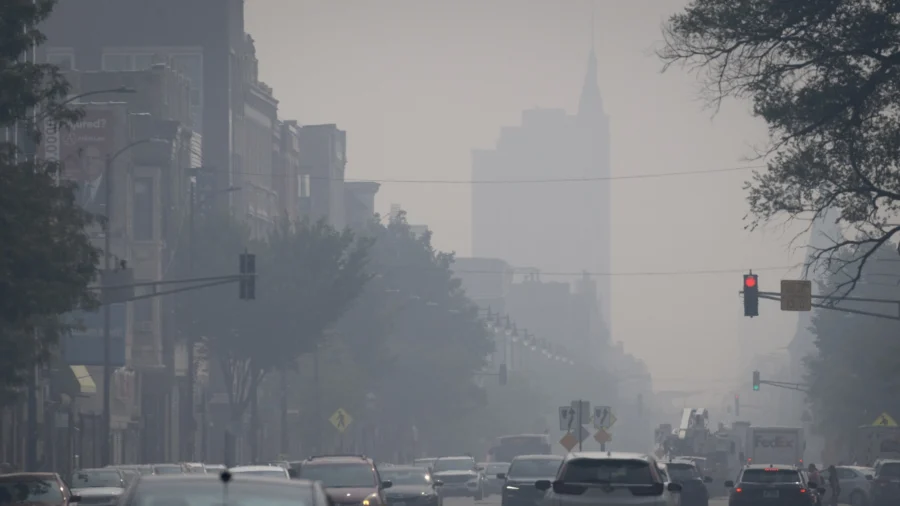
Air quality alerts remained in effect across at least 17 U.S. states on Thursday as thick smoke from Canadian wildfires spread across the Midwest, Northeast, and Mid-Atlantic, prompting officials to urge millions of residents to limit outdoor activity while unhealthy air lingers over much of the region.
The advisories stretch from Minnesota to New Hampshire and south into Virginia as smoke from Canada's ongoing wildfire season continues to move into the United States. According to the
AirNow monitoring system, air quality ranged from unhealthy to hazardous across multiple states, with conditions expected to deteriorate in some areas before improving later this week.
As the smoke settled over major population centers, several cities ranked among the worst in the world for air quality.
IQAir reported on Thursday that Detroit recorded the poorest air quality of any major city globally, with its Air Quality Index climbing into the "hazardous" category.
Minneapolis, Chicago, and Toronto also ranked among the cities with the highest levels of air pollution as dense smoke reduced visibility and blanketed skylines.
New York was among the states under a statewide air quality health advisory as smoke combined with high temperatures to create unhealthy conditions. AirNow
classified parts of central and western New York and the eastern Lake Ontario region as "very unhealthy," while air quality in New York City reached the "unhealthy" category Thursday afternoon.
In response, New York City Mayor Zohran Mamdani encouraged residents to remain in air-conditioned spaces when possible, avoid unnecessary time outdoors, stay hydrated, and check on neighbors who may be more vulnerable to smoke and heat. He said cooling centers were open across the city, free KN95 masks were being distributed, and agencies were moving outdoor programming indoors or adjusting operations as conditions changed.
“Our agencies are mobilizing citywide to support New Yorkers,” a statement
read on X.
Gov. Kathy Hochul said state officials were closely tracking conditions as smoke spread across New York.
"Distant wildfires have impacted New York State in recent years, and this week unfortunately will be no different with expected hazy skies and poor air quality," Hochul said in a
statement. "We are now closely tracking these conditions and I strongly encourage New Yorkers to stay informed and take appropriate precautions to stay safe. Sensitive groups should take particular caution."
The smoke originates from Canada's active wildfire season, where the Canadian Wildland Fire Information System
reported over 800 active wildfires as of Thursday, including more than 30 new fires that ignited overnight. Of those, over 100 were burning out of control.
Forecasters
expect shifting winds to carry smoke farther south through Friday, expanding poor air quality into parts of Ohio, Virginia, Maryland, and the District of Columbia before conditions gradually improve in portions of the Northeast later in the weekend.