


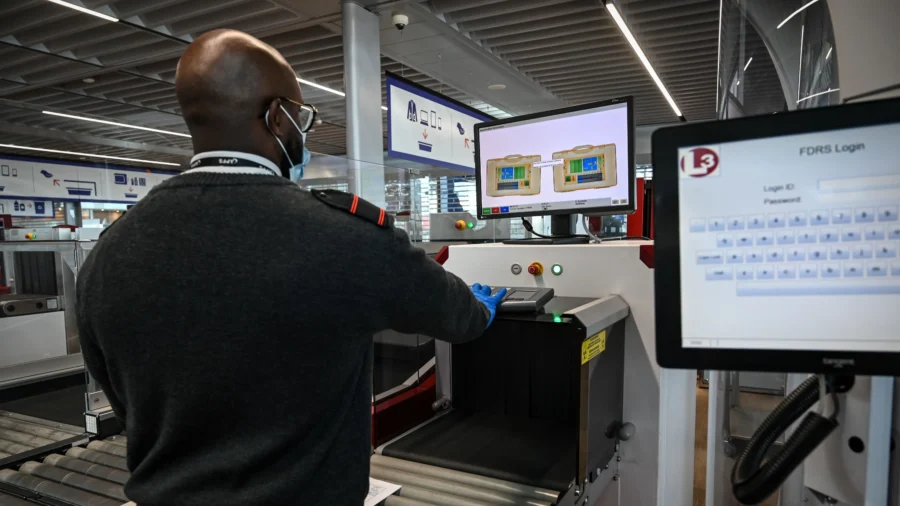
China has told companies within the country not to comply with the European Union’s anti-subsidy investigation into Nuctech, a major Chinese manufacturer of airport security equipment.
The regime’s Ministry of Justice said that, along with the Ministry of Commerce and other departments, it had determined the EU’s cross-border probe involving Nuctech constitutes “improper extraterritorial jurisdiction,” and violates China’s regulations, according to an online statement on May 15.
No entities or individuals should comply with or aid the EU’s actions, the ministry said, adding that the order is effective immediately.
The move marked the first application of a new regulation enacted in April, which was designed to shield domestic companies from foreign measures the communist regime deemed “improper extraterritorial jurisdiction.”
Nuctech is a state-owned provider of security equipment—including X-ray scanners, explosive detectors, and thermographic cameras—and related services for airports, ports, and customs points at borders worldwide.
The European Commission said at the time that its preliminary findings suggested several actions taken by Beijing affecting the state-owned company may constitute foreign subsidies, including grants, preferential tax treatments, and preferential financing arrangements.
European regulators voiced concerns that Beijing’s state subsidies may give the Chinese company an unfair advantage over its European competitors.
“Threat detection systems, including security and inspection scanners used at ports and airports, play an essential role in ensuring that Europe is open, yet secure,” Teresa Ribera, the bloc’s antitrust chief, said in a December 2025 statement. “So we want a level playing field on the market for such systems, keeping fair opportunities for competitors, customers such as border authorities.”
In the latest statement, the Chinese commerce ministry accused European regulators of seeking “broad and unnecessary information” from companies within China and demanding cooperation from Chinese banks in the investigation into Nuctech.
The commerce ministry claimed that the normal operations and investment activities of many Chinese businesses and banks have suffered “serious negative” impacts from related EU actions, and reiterated the regime’s opposition to the EU’s Foreign Subsidies Regulation.
Since that regulation came into force, Brussels has repeatedly invoked it to investigate Chinese companies, a Chinese justice ministry spokesperson said in a separate statement on May 15, condemning these actions as discriminatory.
Under the bloc’s Foreign Subsidies Regulation, companies found in breach could face fines of as much as 10 percent of their global revenue.
In April 2024, the European Commission conducted unannounced inspections of Nuctech’s facilities in Poland and the Netherlands, prompting the Chinese company to sue the Commission at the General Court in Luxembourg, Europe’s second-highest court.
In the United States, the U.S. Department of Commerce in 2020 added Nuctech to its trade blacklist in 2020 over national security concerns.