


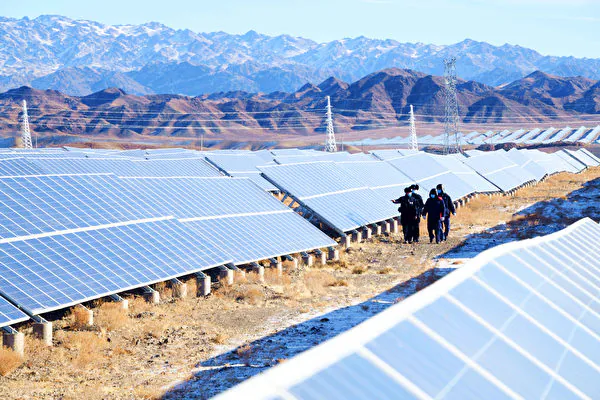
The sell-off reflects a trend in China’s economic planning—state-backed companies pour into government-favored sectors, rapidly expand capacity, and eventually leave behind oversupply, collapsing prices, and mounting financial losses.
Thirty-seven equity transactions involving renewable energy companies were recorded during the first half of 2026, according to Chinese state-controlled news Sina Finance on June 16. State-owned entities accounted for roughly 65 percent of the sellers, while about 60 percent of the deals involved transfers of controlling stakes.
In one notable case, Shanghai Electric transferred a 47.4 percent stake in an energy storage joint venture in May for a symbolic price of one yuan ($0.15). Separately, China Three Gorges Corporation sold a 49 percent stake in a renewable energy company in Henan Province for the same amount.
China General Nuclear Power Group sold a 90 percent stake in a solar company in Sichuan Province, while the State Grid Corporation of China transferred ownership of three renewable energy subsidiaries in Shanxi, Jilin, and Shandong provinces.
The scale of the divestments has drawn attention due to the sellers being the Chinese regime’s state-owned enterprises, which traditionally enjoy preferential access to financing and government support. Their willingness to exit at deeply discounted prices suggests an urgency to shed underperforming assets.
Most of the transactions involved loss-making projects. Fourteen of the 37 deals were complete disposals of 100 percent ownership stakes, while 22 involved transfers of more than 50 percent ownership.
A Familiar State-Led Cycle
Mike Li, a veteran Chinese media professional, told The Epoch Times that the developments reflect a longstanding pattern in China’s state-dominated economy.“When a new industry becomes politically favored, state-owned enterprises use their financial advantages and market position to rush into the sector,” Li said. “The problem is that they often create overcapacity within a very short period of time, driving down prices and profitability.”
Since 2025, China’s renewable energy sector has entered a period of overcapacity and restructuring, triggering price wars, bankruptcies, and a growing wave of asset sales.
The solar industry has been hit particularly hard.
Years of aggressive expansion across the entire supply chain have created production capacity far beyond domestic and international demand. The result has been widespread losses and a sharp decline in new investment.
According to a Sina Finance report in April, more than 100 renewable energy companies had been listed for sale across Beijing, Shanghai, Guangdong, and other regions since the start of 2025. Roughly 90 percent were affiliated with state-owned enterprises. Data showed that more than 50 solar-related companies exited the market during the first half of 2025.
Sina Finance reported that China’s 20 largest solar companies collectively lost more than 60 billion yuan ($8.86 billion) in 2024 as intense competition and excess production capacity squeezed margins.
Echoes of China’s Wind Power Boom
Li said the current downturn mirrors China’s earlier wind energy expansion over a decade ago.Between 2005 and 2015, the Chinese regime’s policies encouraged state-owned enterprises and local governments to invest heavily in wind projects, according to Li. During that period, China’s wind generation capacity surged from roughly 1 gigawatt to more than 140 gigawatts, surpassing the United States to become the world’s largest wind power market.
However, Li said the rapid expansion exposed major structural problems. Many wind farms were built in remote western regions, while the country’s largest electricity demand is concentrated along the eastern coast.
As a result, transmission infrastructure struggled to keep pace, according to Li. Large amounts of generated electricity could not be delivered to consumers, leading to widespread “wind curtailment”—a phenomenon in which turbines remain idle despite favorable wind conditions.
Li said local governments, eager to boost economic growth and investment figures, often approved projects with insufficient planning or resource assessments, contributing to duplication and oversupply.
The same dynamic, he said, is now visible across newer sectors such as solar power and electric vehicles.
“The development model is almost identical to what happened during the wind power boom,” Li said. “If it continues this way, the risk of a similar collapse is very high.”