


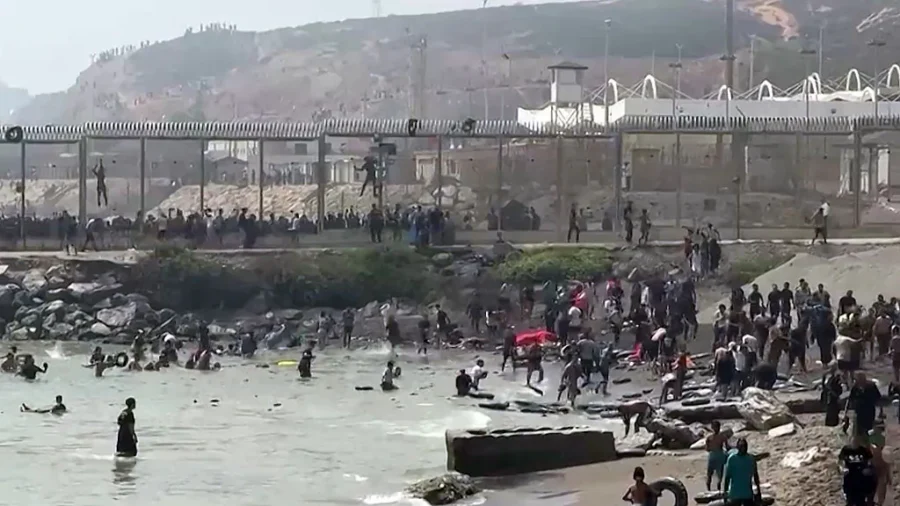
President Donald Trump used the recent surge of migrants crossing into Spain to reinforce his argument for tougher immigration policies, warning it could happen in the United States under a change of leadership.
"It's terrible. Remember that picture. That's going to be us in three years if the wrong side gets in," Trump told reporters Friday.
Images from the Ceuta migration surge show a chaotic scene at the Spain-Morocco border, with large groups of migrants arriving by sea and gathering near crossings, climbing fences and rushing toward border reception facilities.
Trump pointed to the images as evidence of consequences to weak immigration enforcement.
Spanish officials blamed the surge on misinformation spread online that suggested migrants arriving by sea would be allowed to stay in Spain. After reports circulated on social media about a Spanish Supreme Court ruling earlier in July that migrants intercepted at sea while attempting to reach Ceuta or Melilla could not be immediately returned, many capitalized on it as a chance to make the crossing, authorities said.
The State Department on Friday reiterated Trump's stance and blamed the Spanish government for the surge.
“We are considering actions to defend Americans at home and abroad from this threat and stand ready to assist other European allies considering similar options,” it added.
For now, Prime Minister Pedro Sánchez said Spain would install buoys in the sea as a temporary measure to create a physical barrier and strengthen border controls.
Spanish officials and migration experts have cited several other factors behind the surge, including economic hardship and illegal smuggling activities, noting that migration movements are typically driven by a combination of political, economic and social pressures.
Immigration remains a central political issue in the United States and Europe. Supporters argue that stronger enforcement measures are needed to combat illegal immigration and protect national security, while critics say that isolated border incidents should not be used to define overall migration trends or policy decisions.