


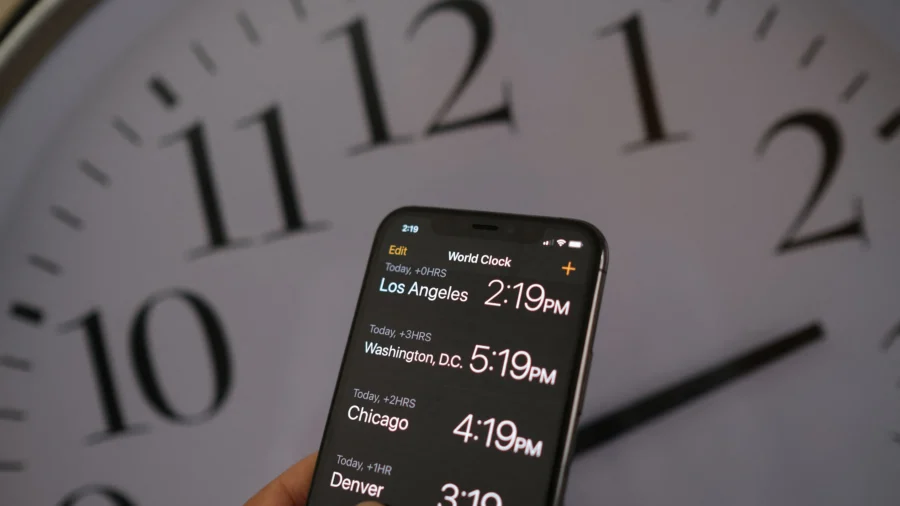
Most Americans will set their clocks ahead by one hour early Sunday as daylight saving time begins for 2026.
The shift will occur at 2 a.m. local time on Sunday, when clocks move forward to 3 a.m. The change marks the start of the annual daylight saving period, which runs until 2 a.m. on Nov. 1, when clocks return to standard time.
According to the National Institute of Standards and Technology, the daylight saving period in 2026 will last 238 days, covering roughly 65 percent of the calendar year. Advancing clocks by one hour effectively transfers an hour of daylight from the morning to the evening during the warmer months.
Many modern electronic devices automatically adjust to the new time if automatic date and time settings are enabled. Companies, including Apple, Google, and Samsung, have support pages for people who need assistance with their times.
This shift can also be seen in sunrise and sunset schedules compiled by the National Weather Service. In Albany, New York, sunrise on Saturday is listed at 6:21 a.m. with sunset at 5:52 p.m. After the clock change on Sunday, sunrise moves to 7:19 a.m. while sunset shifts to 6:53 p.m., creating later daylight in the evening.
The timing of daylight saving time is determined by federal law. According to the U.S. Naval Observatory, the current schedule, beginning on the second Sunday in March and ending on the first Sunday in November, was established by Congress through the Energy Policy Act of 2005 and has been in place since 2007.
Earlier federal policies set different dates. The Uniform Time Act of 1966 standardized timekeeping across the country and scheduled daylight saving time to begin on the last Sunday in April and end on the last Sunday in October, according to information published by Congress.gov.
Later legislation moved the start date to the first Sunday in April, beginning in 1987, before the most recent change took effect in 2007.
Daylight saving time in the United States dates back more than a century. Congress first introduced the practice through the Standard Time Act of 1918 during World War I as a way to conserve fuel by making greater use of daylight hours, according to historical information from the Department of War.
The policy was later revived during World War II, when Congress instituted nationwide daylight saving time, often called “war time,” to help conserve energy and support national defense efforts.
Not every part of the United States observes the clock change. Hawaii and most of Arizona remain on standard time year-round, although the Navajo Nation in northeastern Arizona does observe daylight saving time. U.S. territories, including American Samoa, Guam, Puerto Rico, the Northern Mariana Islands, and the U.S. Virgin Islands, also do not participate in the seasonal change.