


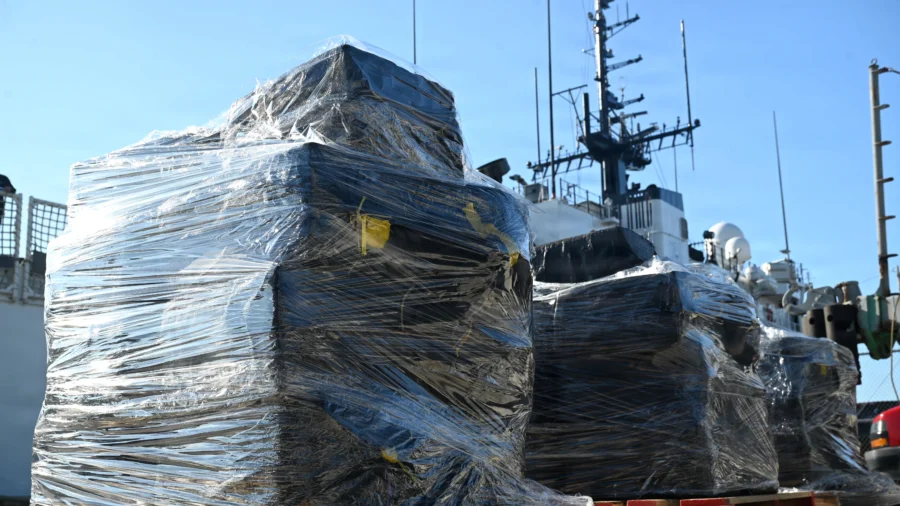
The U.S. Coast Guard recently seized more than $53 million worth of cocaine in two interdictions.
The bust was the result of a wide-reaching interagency effort. Crews from the Coast Guard Helicopter Interdiction Tactical Squadron, Joint Interagency Task Force South, and watchstanders from the Coast Guard Southeast, and Southwest Districts all aided in the operation.
Escanaba's commanding officer said the mission demonstrated the crew's dedication.
"The crew's achievements on this patrol reflect the very best of our service—courage, vigilance, and an unshakeable commitment to protecting the American people," said Cmdr. Nicholas Seniuk. "Every pound of narcotics kept off our streets represents lives changed, violence prevented, and communities made safer. We couldn't be prouder of their extraordinary work."
Record-Breaking Narcotic Seizures
The offload is part of a record-breaking run for the Coast Guard. The service seized more than 511,000 pounds of cocaine in 2025, which is more than three times its annual average. A major driver of that surge has been Operation Pacific Viper, a counter-narcotics campaign launched in August 2025 that officials have called one of the most aggressive maritime drug interdiction efforts in U.S. history.Since its launch, the operation has resulted in the seizure of over 215,000 pounds of cocaine and the arrest of 160 suspected narco-traffickers.
DHS Secretary Markwayne Mullin pointed to the current administration's priorities as vital to the campaign's success. "Operation Pacific Viper plays a central part of President Trump's fight against the cartels at sea, cutting off their ability to make money by trafficking their poison into our country," Mullin said.
The operation has produced a string of record hauls. In August 2025, the USCGC Hamilton offloaded more than 76,000 pounds of drugs valued at $473 million—the largest drug offload in Coast Guard history. The USCGC Stone later brought in over 49,000 pounds worth $362 million in a single patrol, and the CGC Munro returned to California in March after a 119-day, 26,000-mile journey that yielded more than 22,000 pounds of cocaine estimated at $250 million.
Coast Guard officials note that roughly 80 percent of interdictions of U.S.-bound drugs occur at sea, a statistic that shows why the Escanaba and cutters prefer they remain on the front lines. The 270-foot medium endurance cutter is homeported in Portsmouth, Virginia, and operates under U.S. Coast Guard Atlantic Area Command.