


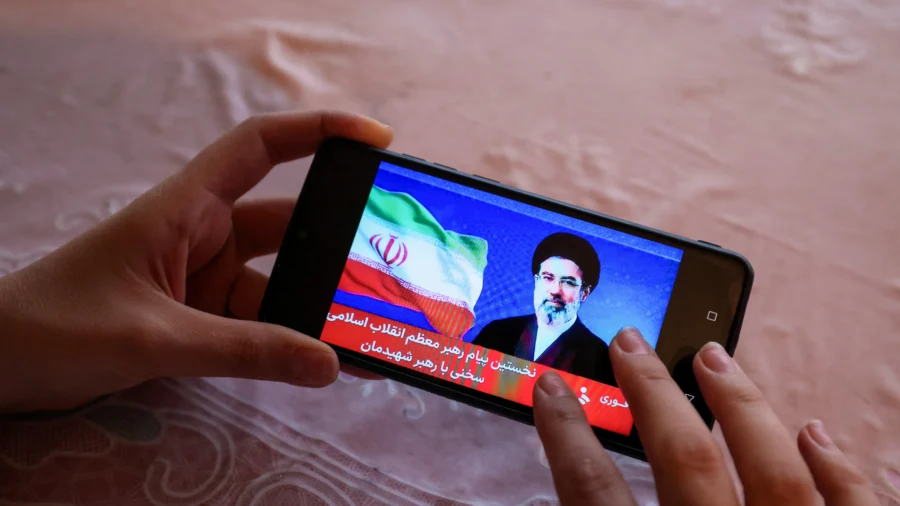
Iran's leader released a statement through state-run media that Tehran will determine new rules over the disputed Strait of Hormuz as a ceasefire between the Iranian regime and the United States holds up.
In a statement released by state-run PressTV, Mojtaba Khamenei—who was named the country's leader in March—said that Iran "will secure the Persian Gulf region and will dismantle the hostile enemy's abuses of this waterway" and that the strait "will be managed by new rules."
“The legal rules and the exercise of the new management of the Strait of Hormuz will bring about comfort and progress to the benefit of all nations in the region, and its economic blessings will gladden the nation's heart,” the statement added.
The strait has been at the center of a dispute between the United States and Tehran as the Iranian regime has effectively blocked the passage of commercial ships through the waterway that connects the Persian Gulf to the Indian Ocean. The closure has sent oil and gas prices surging, with prices reaching more than $4.30 per gallon on average in the United States on Thursday.
Iran's parliamentary speaker and foreign minister have also alluded to Iranian control over the Strait of Hormuz, through which around 20 percent of the world's oil passed prior to the Iran War.
Despite Khamenei's statement, U.S. President Donald Trump said that Iran's oil infrastructure is just days away from suffering severe problems due to crude oil being bottled up, due to an American naval blockade that was initiated earlier this month.
"Something happens where it just explodes," Trump told Fox News on Sunday. "They say they have only three days left before that happens. When it explodes, you can never rebuild it the way it was."
Khamenei's statement came as Trump responded to comments from German Chancellor Fredreich Merz regarding the Iran War.
On April 27, speaking to students in Marsberg, Germany, Merz said: “The Iranians are obviously very skilled at negotiating, or rather, very skillful at not negotiating, letting the Americans travel to Islamabad and then leave again without any result.
“An entire nation is being humiliated by the Iranian leadership, especially by these so-called Revolutionary Guards. And so I hope that this ends as quickly as possible.”
Trump also wrote on Truth Social: "The Chancellor of Germany should spend more time on ending the war with Russia/Ukraine (Where he has been totally ineffective!), and fixing his broken Country, especially Immigration and Energy, and less time on interfering with those that are getting rid of the Iran Nuclear threat, thereby making the World, including Germany, a safer place!"
On Thursday, Japanese Prime Minister Sanae Takaichi said she had spoken with Iranian President Masoud Pezeshkian to ensure the safe passage of a Japanese-related vessel and all other vessels through the strait. Pezeshkian told Takaichi that Tehran would resume diplomacy once Washington changed its behavior.
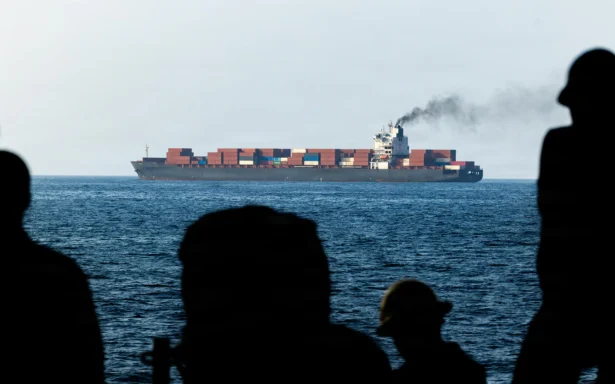
U.N. Secretary-General Antonio Guterres warned that if the disruption caused by the closure dragged on through mid-year, global growth would fall, inflation would rise, and tens of millions more people would be pushed into poverty and extreme hunger.
"The longer this vital artery is choked, the harder it will be to reverse the damage," he told reporters in New York.