


More than a dozen space-themed titles—spanning the earliest days of human spaceflight to speculation about life on Mars—are now available to stream on GJW+, the premium tier of Gan Jing World, an alternative streaming and social media platform.
The lineup drops as public interest in space exploration surges following the Artemis II mission, which carried four astronauts around the moon and returned them safely to Earth—the first humans to see the lunar far side since 1972.
The Apollo Story
The streaming slate opens with the mission that made everything else possible. "Project Gemini: Bridge to the Moon" chronicles the 10 missions of the mid-1960s program that first tested the technologies—spacewalking, orbital docking, and long-duration flight—that NASA required before any lunar landing was possible.From there, the library traces the Apollo program in chronological order. "Apollo 8: Christmas at the Moon" follows the first humans to orbit the moon, who on Christmas Eve 1968 captured the iconic "Earthrise" photograph—an image the Artemis II crew recently recreated. The documentary features insights from NASA personnel and astronauts, including Jim Lovell and Frank Borman. It’s rated PG-13, with English audio and subtitles available in English, Spanish, Vietnamese, simplified Chinese, and traditional Chinese.
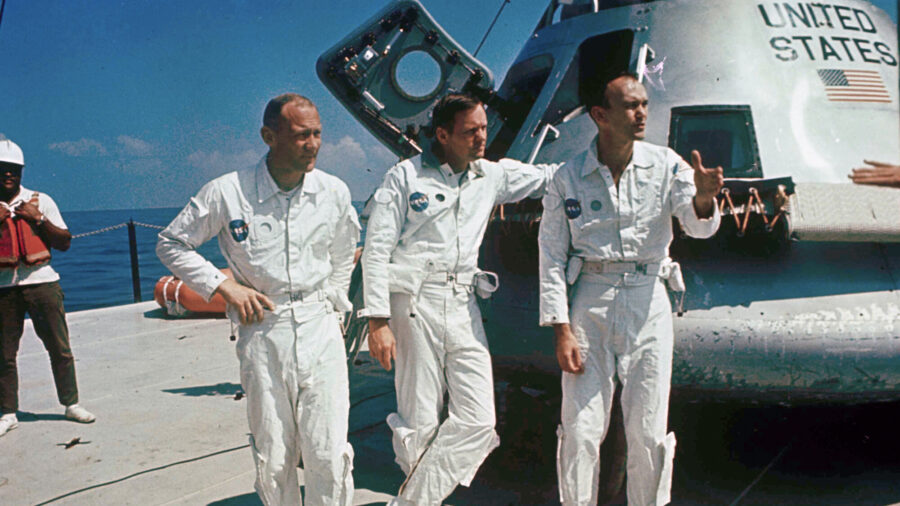
"Apollo 11: First Steps on the Moon" revisits the summer of 1969 and the mission that fulfilled a national mandate set by President John F. Kennedy—to land humans on the moon and return them safely. According to NASA, Apollo 11 launched from Cape Kennedy on July 16, 1969, with Cmdr. Neil Armstrong, Command Module Pilot Michael Collins, and Lunar Module Pilot Edwin "Buzz" Aldrin. An estimated 650 million people watched Armstrong's televised descent to the lunar surface on July 20, 1969, when he spoke the now-famous words describing "one small step for a man, one giant leap for mankind."
Armstrong and Aldrin spent 21 hours and 36 minutes on the surface in the Sea of Tranquility before the mission splashed down in the Pacific Ocean on July 24, after a total flight time of 195 hours, 18 minutes, and 35 seconds. The film is rated PG-13 with the same five-language subtitle options.
"Apollo 13: Home Safe" revisits a mission that nearly ended in catastrophe. Featuring interviews with Apollo 13 astronauts and flight directors, the film chronicles what became known as a "successful failure." On their third day in space—55 hours, 55 minutes, and 4 seconds into the flight—Cmdr. James Lovell, Command Module Pilot John "Jack" Swigert, and Lunar Module Pilot Fred Haise heard a dull bang reverberate through their spacecraft.
According to NASA, mission controllers almost immediately received a computer restart alert and unusual voltage readings across the ship's electrical systems. Swigert radioed Mission Control first: "OK, Houston, we've had a problem here," followed by Lovell reporting a voltage drop on one of the ship's two main DC electrical buses. An oxygen tank in the Service Module had catastrophically failed, forcing the crew to use the Lunar Module Aquarius as a lifeboat and abandon the planned moon landing.
During their loop around the moon, the crew reached 248,655 miles from Earth—a record for the farthest any humans have ever traveled, set in part because the moon was farther along in its elliptical orbit and Apollo 13's closest lunar approach was higher than planned. The film is not rated, and has the same subtitle languages.