


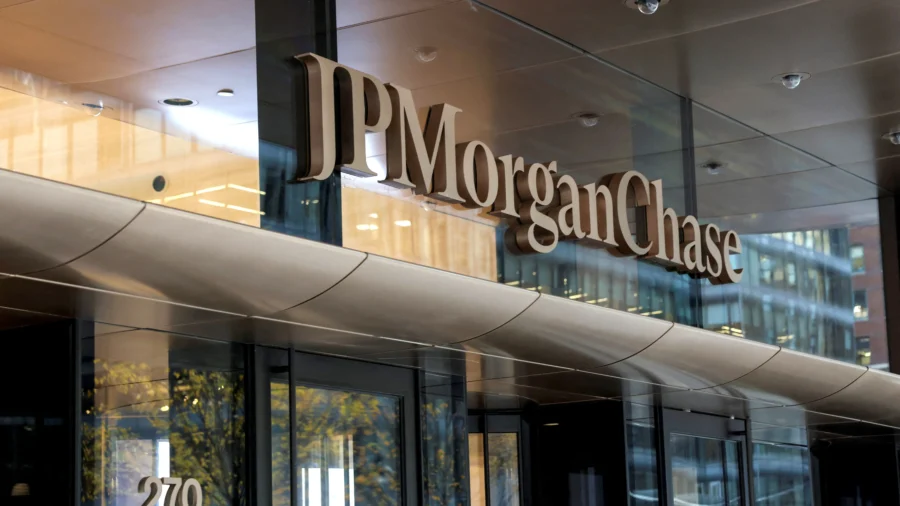
New court documents released Friday show JPMorgan Chase told President Donald Trump a month after the January 2021 breach of the U.S. Capitol that the bank was closing his accounts.
JPMorgan, the largest bank in the United States, did not specify a reason for the account closures in letters it sent to Trump and the Trump Organization on Feb. 19, 2021. One of the letters said the bank has the right to decide that a client’s interests are no longer served by maintaining a relationship with JPMorgan.
Trump has maintained for years that his bank account closures were politically motivated, and a spokesperson for his legal team said the newest court documents are "a devastating concession that proves President Trump's entire claim."
“[JPMorgan] admitted to unlawfully and intentionally de-banking President Trump, his family, and his businesses, causing overwhelming financial harm," the spokesperson said.
The bank told The Epoch Times over email it will seek to dismiss the claims.
"Plaintiffs’ threadbare allegations do not allege sufficient facts to plead a claim," the institution said.
JPMorgan told The Epoch Times last month that the case “has no merit.”
“[JPMorgan Chase] does not close accounts for political or religious reasons,” JPMorgan previously said. “We do close accounts because they create legal or regulatory risk for the company.”
“We regret having to do so, but often rules and regulatory expectations lead us to do so.”
JPMorgan added it supports the Trump administration’s efforts to prevent the weaponization of the banking sector. These comments were made last month, days after Trump announced on social media his intention to sue the bank.
Since then, Trump’s lawyers have alleged in court documents that JPMorgan closed the president’s accounts because of its “‘woke’ beliefs that it needed to distance itself from President Trump and his conservative political views.”
“In essence, [JPMorgan Chase] debanked Plaintiffs’ Accounts because it believed that the political tide at the moment favored doing so,” the lawsuit states.
Its aim is to ensure banks are not withholding their services from individuals or businesses because of political or religious beliefs. The executive order accused financial institutions of “unacceptable practices” and participation in government-directed surveillance programs on people affiliated with conservative causes or activities.
“The Federal Government suggested that such institutions flag individuals who made transactions related to companies like ‘Cabela’s’ and ‘Bass Pro Shop’ or who made peer-to-peer payments that involved terms like ‘Trump’ or ‘MAGA,’” the executive order stated.
Trump also wrote in his directive that banks could face fines, consent decrees, or other punitive actions if they engage in the removal of services for certain individuals.
Following Trump’s account closures in February 2021, conservative and Christian organizations said they had also been victims of debanking.
First Lady Melania Trump also said that she was debanked.
“I was shocked and dismayed to learn that my long-time bank decided to terminate my account and deny my son the opportunity to open a new one,” the first lady wrote in her memoir “Melania.”
The report was published by the Office of the Comptroller of the Currency, which reviewed nine of its largest regulated institutions, including Bank of America, BMO Bank, Citibank, Capital One, JPMorgan Chase Bank, PNC Bank, TD Bank, Wells Fargo Bank, and U.S. Bank.
The agency reviewed thousands of documents from 2020 to 2025 to identify instances of customer complaints of alleged debanking and whether the banks shared private data on individuals or businesses with the federal government for surveillance.
“Many industry sectors were restricted based primarily on how it might appear to the public if the bank provided access to financial services to these sectors,” the report stated.
According to the report, the nine banks restricted services to these sectors: oil and gas exploration, development, or production in the Arctic; coal mining or coal-powered plants; firearms, firearm accessories, or ammunition manufacturing and distribution; private prison construction or operation; payday and payroll lending, consumer debt collection, and repossession agencies; tobacco or e-cigarette manufacturing, online retail, or distribution; adult entertainment; digital asset activities; and political action committees and political parties.
The Office of the Comptroller of the Currency stated it was taking steps to end the weaponization of the financial system.
Trump’s debanking lawsuit was filed in state court in Miami, but JPMorgan is seeking for the case to be brought to federal court in New York.