


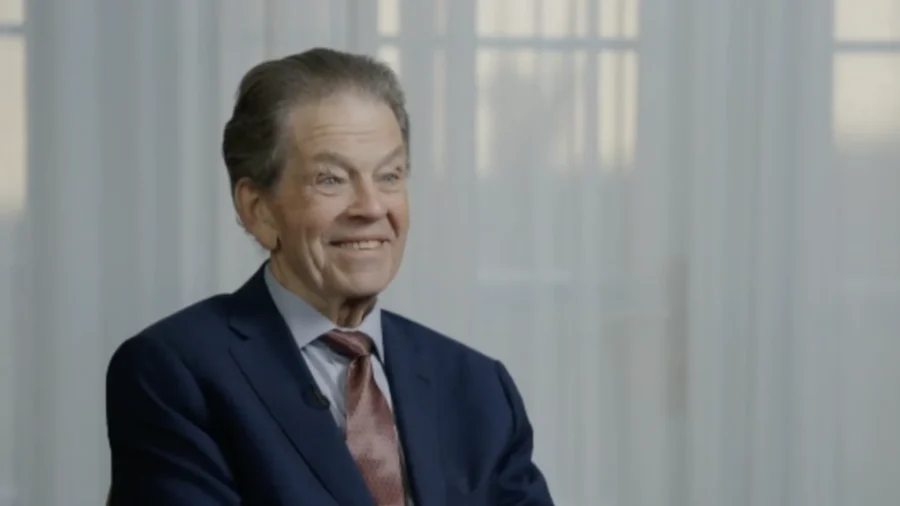
Renowned economist Arthur Laffer, architect of the famous Laffer Curve, says President Donald Trump's recently passed legislation, the One Big Beautiful Bill Act, will usher in a sustained period of economic growth.
He dismissed critics' concern for potential stagflation in an interview with NTD's Washington Bureau Chief Steve Lance, while highlighting provisions in the bill that extend beyond traditional tax policy.
The 85-year-old economist, who advised former President Ronald Reagan, said during the interview that he has "never been more excited and more optimistic" about the country's economic future.
Laffer said that the legislation's primary achievement lies in preventing what would have been substantial tax increases across multiple categories.
"The most important thing of this bill is if it had not passed, there'd be a huge tax increase, both personal income tax, death tax, depreciation, schedules, all of these things," Laffer said. "Passing this makes those tax cuts permanent. It doesn't lower those taxes, but it does make them permanent, which is really, really important to avoid a big downturn."
The bill maintains the current top personal income tax rate at 37 percent, preventing it from rising to 39.6 percent when previous provisions were set to expire.
Beyond tax policy, Laffer highlighted several provisions he considers transformative for long-term economic growth. The legislation includes healthcare price transparency requirements, which Laffer described as potentially game-changing for a sector representing 17 to 18 percent of the country's GDP.
"Health care price transparency means that the health care providers have to have to tell you what the prices of things are and what the consequences of those things are as well, so you can make good, rational decisions," he said.
Growth Projections and Economic Outlook
Laffer projected sustained economic growth in the 3 to 4 percent range over the next decade, comparing the potential trajectory to the Reagan era's economic expansion."You could even get a little bit higher over the next 10 years," he said. "I really think the U.S. is on the trajectory to really reestablish prosperity."
Federal Reserve Changes Expected
The economist signaled potential changes at the Federal Reserve, adding that he supports the idea of replacing current Chairman Jerome Powell. Laffer specifically endorsed Kevin Warsh as a preferred candidate, praising his understanding of monetary policy focused on price level stabilization."Powell needs to be replaced. He's just not a good Fed chairman," Laffer said. "Kevin Warsh is absolutely spectacular."
Laffer advocated for a return to Paul Volcker-era monetary policy, emphasizing price stability over interest rate manipulation.
When asked about economist Larry Summers' warnings of potential stagflation, Laffer strongly disagreed, pointing to the success of previous tax reduction policies.
"I think he's completely incorrect for the reasons I just enumerated," Laffer said. "They were all wrong on the tax cuts and Jobs Act."
Trade and Deregulation
Laffer called for cautious optimism about ongoing trade negotiations, particularly with Japan regarding automotive imports. He recalled previous studies showing non-tariff barriers adding $50,000 to 60,000 to make U.S. cars road-ready in Japan."They should treat us the same way we treat them, period. And that's what Trump is trying to find, and I think he's been pretty successful so far," he said.
He also highlighted expected benefits from deregulation, particularly in energy sectors, as part of a comprehensive approach spanning "the five grand kingdoms of macroeconomics”—tax, spending, monetary, regulatory, and trade policies.
Reflecting on his decades of economic analysis, Laffer reiterated his core philosophy: lower tax rates ultimately generate higher revenues and broader prosperity.
"Have you ever heard of an economy taxed into prosperity?" he asked rhetorically. "The best form of welfare, as Kennedy put it, is a good, high-paying job."
With the legislation now in place, Laffer argued that economic performance will definitively reflect Trump's policies, stating: "It is Trump's economy. He got what he wanted on the BBB, and now it's Trump's turn to perform."