


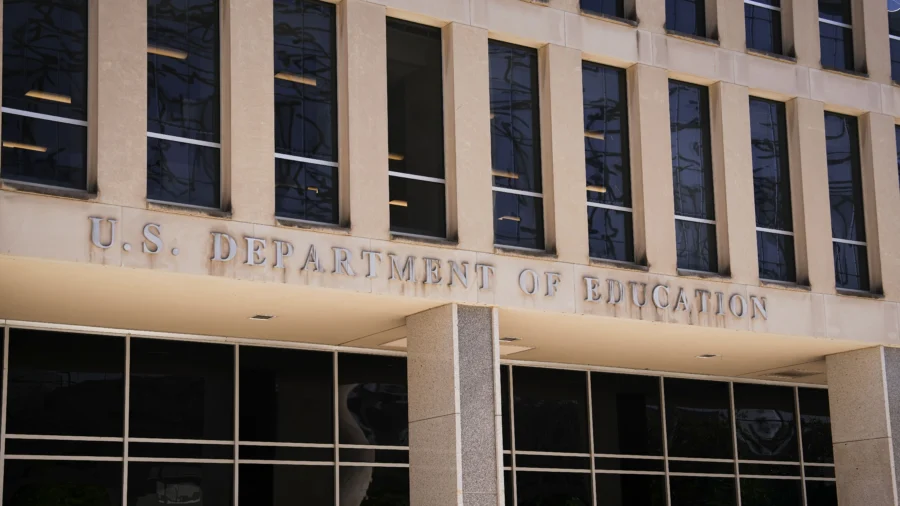
The U.S. Department of Education has stopped awarding grants to colleges based on the share of minority students they enroll, saying it is unconstitutional to use taxpayer dollars to promote “racial or ethnic quotas” at those schools.
For instance, a Hispanic-Serving Institution (HSI) must enroll at least 25 percent Hispanic students, among other criteria, to earn the designation. A Predominantly Black Institution (PBI) must enroll at least 1,000 undergraduates and make sure that at least 40 percent of them are black to unlock the corresponding grant.
“Discrimination based upon race or ethnicity has no place in the United States,” the secretary said. “The Department will no longer award Minority-Serving Institution grants that discriminate by restricting eligibility to institutions that meet government-mandated racial quotas.”
“Diversity is not merely the presence of a skin color,” she continued. “Stereotyping an individual based on immutable characteristics diminishes the full picture of that person’s life and contributions, including their character, resiliency, and merit.”
Several grant programs are set to be eliminated, including those for HSIs, PBIs, Alaska Native and Native Hawaiian-serving institutions, Native American and Pacific Islander-serving institutions, and Native American-serving non-tribal institutions.
The change does not affect Historically Black Colleges and Universities (HBCUs), which are defined by their history of educating African Americans before the end of segregation in 1964, rather than by the current racial composition of their student body. Nor does it affect tribal colleges, which derive their status from being chartered by tribal governments and located on or near reservations.
For fiscal 2025, Congress had appropriated about $350 million in discretionary funds for MSI programs across the nation. The Education Department said it will still distribute roughly $132 million in mandatory funds that “cannot be reprogrammed on a statutory basis,” while redirecting the remainder toward “programs that do not include discriminatory racial and ethnic quotas and that advance administration priorities.”
Looking ahead, McMahon said she wants to transform MSI programs so that they still support colleges with large minority student populations but are no longer tied to racial thresholds.
“The Department looks forward to working with Congress to reenvision these programs to support institutions that serve underprepared or under-resourced students without relying on race quotas, and will continue fighting to ensure that students are judged as individuals, not prejudged by their membership in a racial group,” she said.
Several university administrators and lawmakers have voiced concerns about the change. University of Hawaii, a recipient of two now-terminated MSI grants, said it will have to adjust how it allocates resources.
Chairs of three House caucuses—Rep. Grace Meng (D-N.Y.) of Asian Pacific American Caucus, Rep. Adriano Espaillat (D-N.Y.) of Hispanic Caucus, and Rep. Yvette Clarke (D-N.Y.) of Black Caucus—condemned the decision, saying it would undercut educational opportunities for students across the nation.