


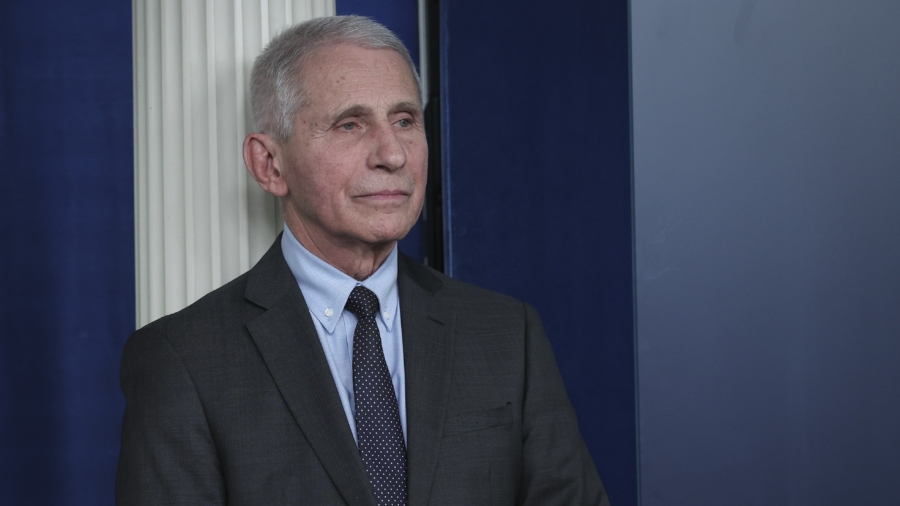
Elon Musk has said that internal Twitter documents containing revelations about the former White House chief medical adviser Dr. Anthony Fauci would be released within days, in what's been dubbed the "Fauci Files."
Twitter Files on COVID-19
Musk took over Twitter in October and vowed to try and cleanse the platform of political bias in content moderation. He has enabled the release of a string of so-called "Twitter Files," or internal company discussions that lift the lid on the inner workings of the social media giant's censorship machine.Internal emails published by journalist David Zweig show that there were “countless instances” of Twitter posts being taken down or labeled as “misleading” because they differed from the U.S. Centers for Disease Control and Prevention guidelines or “establishment views” around COVID-19 or vaccines.
Fauci became a household name in the United States following the COVID-19 outbreak, giving over 1,000 interviews to various news outlets since early 2020 and drawing both praise and criticism for his grim warnings and support for harsh measures including lockdowns.
For instance, in October 2020, Fauci publicly recommended that then-President Donald Trump “shut the country down,” although it’s not clear what he meant, as presidents don’t have the authority to impose sweeping lockdowns.
Fauci acknowledged some missteps in the fight against the pandemic in a Dec. 25 interview with The Guardian.
Overall, however, Fauci insisted that "we tried our best given our best judgment and our analysis of what was going on around us to make recommendations."
One of those who's been critical of Fauci over his recommendations to impose COVID-19 restrictions is Musk, who strongly opposed lockdowns.
'Fauci Fan Club'
Musk said on Dec. 28 that Twitter employees had an internal group on the Slack messaging system that was "unironically called 'Fauci Fan Club.'"Musk's post noted that the Fauci fan club was set up despite outstanding "glaring issues" regarding Fauci, including the question of whether the White House adviser was untruthful when he denied that U.S. federal money was used to fund risky "gain-of-function" research at a Chinese lab at the center of speculation about the origins of the COVID-19 pandemic.
'Gain-of-Function'
The documents obtained by The Intercept detail the work of the EcoHealth Alliance, a U.S.-based health organization that used federal money to fund research into bat coronaviruses at the Chinese lab in Wuhan.Some have argued that the documents show that research funded by EcoHealth in China amounted to "gain-of-function." This type of research involves altering the properties of a pathogen, such as its virulence, in order to study its potential impact on human health. Gain-of-function research is controversial because of the potential risks it poses.
EcoHealth, NIH, and NIAID that Fauci headed at the time have denied that the funding amounted to gain-of-function research, while Fauci himself has repeatedly insisted that it did not.
"No one knows exactly what counts as gain-of-function, so we disagree as to what needs oversight, much less what that oversight should be," said Nicholas Evans, an associate professor of philosophy at the University of Massachusetts, Lowell, who specializes in biosecurity and pandemic preparedness, in remarks to ASBMB Today.
But Richard Ebright, a molecular biologist at Rutgers University, has insisted the research amounted to gain-of-function and that Fauci and others lied when insisting it was not.
'Lockdowns May Claim 20 Times More Life Years Than They Save'
At the height of the outbreak, Fauci repeatedly backed harsh measures that were believed to help contain COVID-19, including lockdowns.Some studies have identified lockdowns as contributing to jumps in suicides, mental health crises, learning loss, and delayed health treatments.
"Our results show that major non-pharmaceutical interventions—and lockdowns in particular—have had a large effect on reducing transmission," wrote the authors of the study backing restrictive measures, though the research did not evaluate any unintended impacts of the measures.
But a recent study that looked at a wide array of research into lockdowns concluded that such measures can be an effective tool in controlling the COVID-19 pandemic, but only if "long-term collateral damage is neglected."
That study's authors also said that what deserves a "special and urgent analysis" is the question of "to what extent, why, and how the dissenting (disapproved by healthcare officials) scientific opinions were suppressed during COVID-19."
"Suppression of 'misleading' opinions causes not only grave consequences for scientists’ moral compass; it prevents the scientific community from correcting mistakes and jeopardizes (with a good reason) public trust in science," they wrote.
Republicans said earlier this year that if they retake the House in the midterm election—which they have now done—they will pursue a COVID-19-related investigation and would seek Fauci's testimony.
Fauci, for his part, has said he'd be willing to testify.
“I have no trouble testifying—we can defend and explain everything that we’ve said,” he added.