


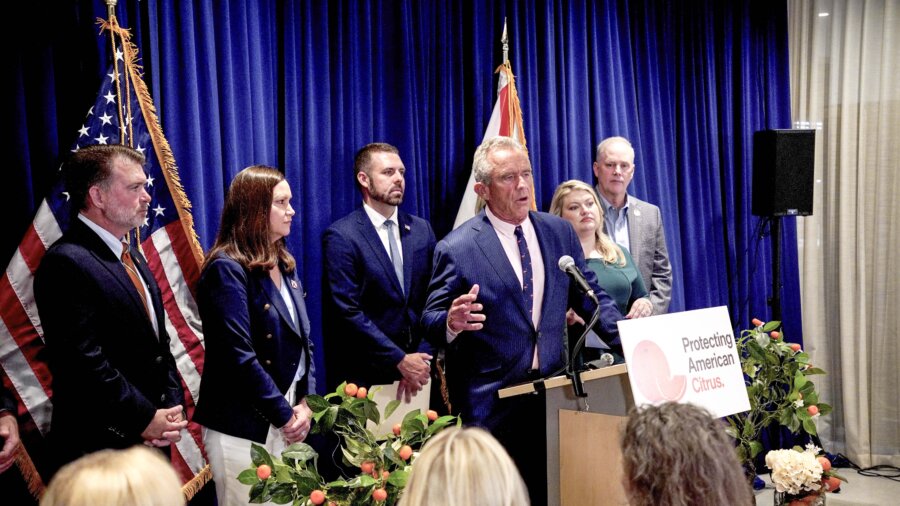
LAKELAND, Fla.—Health and Human Services Secretary Robert F. Kennedy Jr. on July 17 announced that the Food and Drug Administration (FDA) has changed its regulations on the required sugar content for pasteurized orange juice.
Citrus greening starves orange trees of nutrients, killing roots while reducing the sugar content in the few fruit that survive the systemic infection.
Four years ago, the popular Florida’s Natural orange juice company—which had until then touted its formula for containing 100 percent Florida oranges—announced it would begin using a blend of fruit from the United States, Brazil, and Mexico after the Sunshine State’s citrus industry free fall.
While the FDA rule change does not address the citrus greening disease that has caused Florida oranges to nearly disappear from grocery stores nationwide, Kennedy said lowering the “standard of identity” for pasteurized orange juice—which measures its dissolved sugar content—should allow juicers to utilize more oranges from the Sunshine State in their blends.
“Federal regulations have required pasteurized orange juice sold in the United States to contain at least 10.5 degrees Brix, which is a measurement of dissolved sucrose,” Kennedy told reporters at a press conference at Bonnet Springs Park in Lakeland, Florida, on Friday. “But hurricanes, citrus greening disease, and other extraordinary events have devastated Florida's historic citrus groves, naturally reducing the sugar content of many Florida oranges.”
“Even though Florida growers continue to produce high-quality fruit, orange juice companies have had to import higher sugar content oranges, mainly from Brazil … in order to satisfy these outdated requirements.
“The regulations hurt our economy [and] drove up costs; they cost American jobs and unnecessarily force higher sugar levels in orange juice,” Kennedy added, calling the rule change a “decisive victory for American farmers.”
Sen. Ashley Moody (R-Fla.), who also spoke at Friday’s press conference, said she introduced a bill in the Senate to mandate the proposed rule change before the FDA ultimately approved it without the need for additional legislation.
“I don't know why it wasn't changed previously, but I can tell you there were a lot of us [who] were speaking out about it in the last year since Secretary Kennedy took over,” Moody told reporters.
Invasive Insects Cause Industry Demise
While the rule change will likely make it easier for juicers to utilize Florida-grown and other U.S.-sourced oranges in their products and reduce the need for imported fruit, it still leaves open the question of how citrus farmers will endure with so much uncertainty after greening disease has nearly wiped out Florida’s entire industry.The culprit for the industry’s near total demise—the Asian citrus psyllid—entered the United States from China in 2005.
Concerns over invasive insects kicked into high gear last month after the United States saw its first New World screwworm case in nearly a decade. Before a localized case in the Florida Keys in September 2016, researchers had previously spent millions eradicating the pest from the United States in the 1960s.
Last year, the Trump administration faced criticism for cutting an estimated 23 percent of the workforce at the Animal and Plant Health Inspection Service (APHIS), a critical Department of Agriculture subagency that is responsible for preventing and responding to invasive species threats in the United States.
Sen. Jeff Merkley (D-Ore.), along with a group of other Senate Democrats, co-wrote a letter last month to Agriculture Secretary Brooke Rollins, arguing that “the nationwide loss of these resources and functions threaten[s] America’s ability to respond to emerging challenges.”
In response to a question from The Epoch Times on whether he has had conversations with Rollins about potentially increasing resources at APHIS to respond to both the screwworm threat and other invasive insects like the Asian citrus psyllid, Kennedy said the Agriculture Department is actively responding to the screwworm outbreak.
“The issue with screwworm is that the breeding programs for the screwworm predator were discontinued, and that the Central American governments did not have their own programs,” Kennedy said, noting that while it was previously eliminated from the United States and Mexico, “There were reservoirs of it waiting in Central America.”
He added that the Agriculture Department has “dramatically increased the production of those antiparasitic organisms” to combat screwworm cases and limit its spread.
“We are releasing them now, all over Texas and all over Mexico, and we're going to continue to do that,” Kennedy said.