


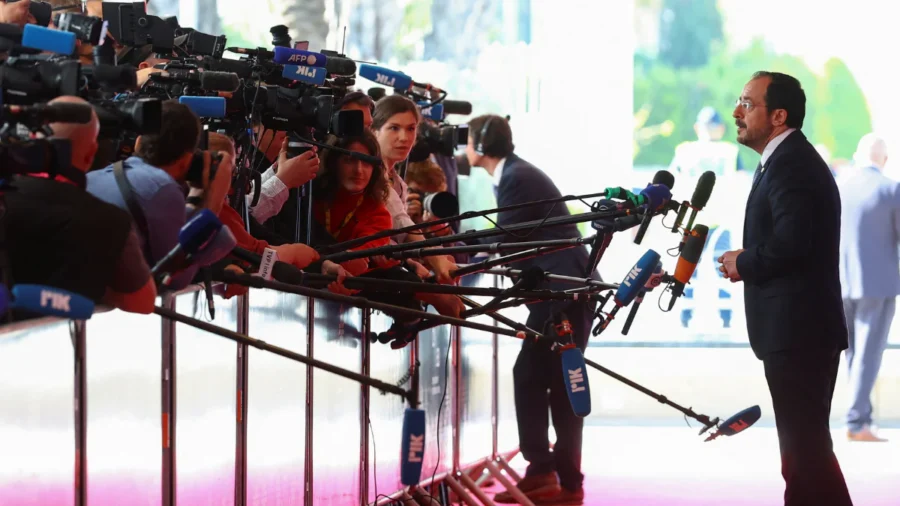
European Union leaders have tasked their officials with fleshing out how a rarely used Brussels treaty on mutual assistance would work in the event a member is the victim of military aggression.
Cypriot President Nikos Christodoulides, whose country currently holds the rotating EU Council presidency, said on April 24 that leaders made the agreement at a summit in Cyprus the night before.
"We agreed last night that the Commission will prepare a blueprint on how we respond in case a member state triggers Article 42.7," Christodoulides told reporters.
Article 42.7 says that if a member state is a victim of "armed aggression" in its territory, other members are obliged to assist it to the extent of their ability to provide aid.
The EU says that assistance can range from "diplomatic support and technical and medical assistance to civilian or military aid."
Unlike NATO's Article 5 collective defense pact, Article 42.7 of the TEU is not backed by detailed operational plans or military structures.
Christodoulides said that the blueprint should be able to provide directives on which countries should be the first to respond to calls for assistance, as well as include other details.
"All those [questions] are going to be put in a blueprint in order to know when—and if—a member state triggers Article 42.7 to have an operational plan to put in action," he said.
While most EU members are in NATO, not all are, including Austria and Cyprus, meaning that for some countries, this could form their first meaningful structure for guaranteeing this kind of mutual assistance.
"I'm very happy that all member states—and the member states that are NATO members, but also those countries that are not NATO members—they see the necessity to have an operational plan when Article 42.7 [is triggered]," Christodoulides said.
According to the EU, the article has only been invoked once so far, by France, following the 2015 terror attacks when Islamists killed 130 people at multiple targets, including during a concert at the Bataclan in Paris.
NATO Still Key to Collective Defense
While the bloc is seeking to formalize its own mutual defense strategies, some member nations have sought to convey that Europe is not turning away from NATO and its Article 5 mutual defense pact."For me, it is an absolutely crucial thing that Article 5 is the key of our collective defence and collective security, and it will remain so," Lithuanian President Gitanas Nauseda told reporters on April 23.
Article 5 states that an attack on one member of NATO is considered an attack on all the members.
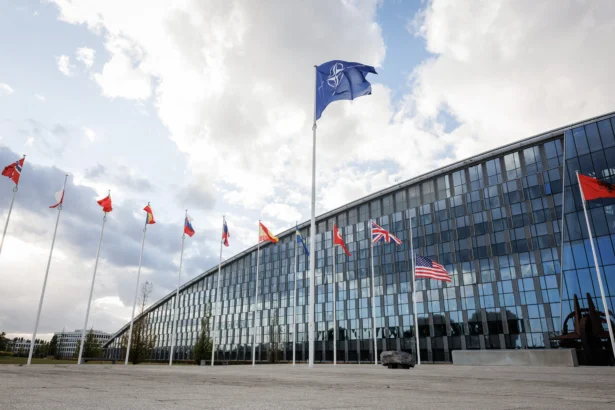
Similarly, Latvian Foreign Minister Baiba Braze said it "sees NATO as the cornerstone of collective defence."
"The possible activation and further development of Article 42.7 should go hand in hand with NATO, seeking synergies, and would in no way be regarded as a sign of distrust in NATO or as weakening the Alliance," she said in a statement on April 23.
Washington's Defense Priorities
The move by Brussels to affirm its own mutual defense strategies comes amid recognition from the bloc of the United States' reorientation of defense priorities away from the rest of the world and toward homeland defense and the defense of U.S. interests in the Western Hemisphere.However, Kallas emphasized the United States’ role in NATO.