


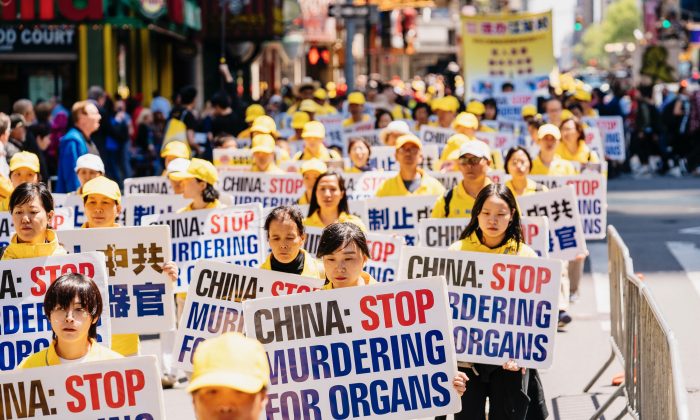
Some members of the European Parliament are demanding action to combat organ harvesting after experts gave evidence at a Nov. 29 subcommittee hearing confirming that the communist Chinese regime has been harvesting organs from prisoners of conscience on a large-scale.
“It means taking people, the Falun Gong, killing them, ripping out all their organs to sell on the commercial market.”
The Chinese regime is making enormous profit by supplying its transplant industry with harvested organs. Based on estimates, Nice said that each cadaver could generate up to around half a million dollars when fully exploited.
Martin Elliott, professor of Paediatric Cardiothoracic Surgery at University College London who was on the tribunal panel, explained to the E.U. lawmakers different pieces of evidence that the tribunal relied upon to reach its conclusion. One such evidence was the “number of registered donors has always been significantly lower than the transplants performed” in China, meaning that there was “some hidden donor pool,” he said.
“Transplants were being carried out in the order of 60,000 to 90,000 a year at that time,” Elliott said.
The professor said prisoners of conscience were being subjected to medical tests, further pointing to the grisly practice.
“We heard further evidence that these inmates were subjected to blood tests for uncertain reasons, [and] ultrasound examination of their organs,” Elliot said.
Such tests are used if you wasn to “establish that the prisoners were either healthy or well, or that their organs are in good condition,” he added.
But given that many of the detainees were subjected to torture at these facillities, “it’s difficult to imagine” that the tests had any other purpose than to test for organ health, the professor said.
For years, China has been a top destination for transplant tourism since Chinese hospitals offer a waiting time as short as days. In contrast, in Western countries, the typical waiting time for an organ transplant is months, if not years. Such a short wait-time in China, Elliott argued, could “only be explained by a latent pool of donors.”
Isabel Santos, a Portuguese politician and a member of the subcommittee, said through a translator that the annual transplant figure presented by Elliott “really does show the industrial scale” of China’s organ harvesting practices.
“It really shows us how urgent it is for us to reflect on joint action. It cannot just be E.U. action. It needs to be joint action undertaken by all international organizations to fight this scourge,” Santos said.
She added, “We also need to criminalize those who benefit or make use of this practice. That does seem to be the only way that we're going to be able to fight this type of crime.”
Maria Soraya Rodriguez Ramos, a Spanish politician and a member of the subcommittee, said through a translator that China’s organ harvesting was really “murder on an industrial scale.” She also questioned whether the E.U. should strengthen legal protection to ensure “none of those organs reach our member states.”
Dominic Porter, the head of division for China, Macao, Taiwan, and Mongolia from the E.U.’s diplomatic arm European External Action Service (EEAS), told the subcommittee that the external ministry has “repeatedly expressed concerns” about the “secrecy” around China’s death penalty and organ transplant statistics.
“So let me be clear that the E.U. condemned in the strongest terms the criminal, inhumane and unethical practice of forced organ harvesting,” Porter said.