


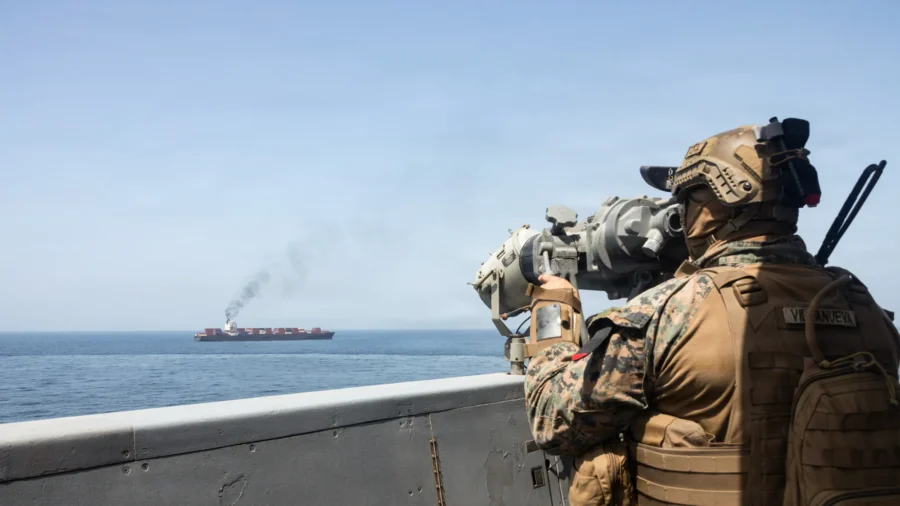
The U.S. military said early Saturday that it had downed several Iranian attack drones targeting commercial ships sailing through the Strait of Hormuz, which comes as negotiations between Washington and Tehran to settle the conflict diplomatically are nearing a critical phase.
"Iran launched multiple one-way attack drones in an attempt to strike commercial ships transiting the Strait of Hormuz," U.S. Central Command (CENTCOM) said in a June 13 post on X.
The command said U.S. forces neutralized all of the attack drones over the span of several hours, and that traffic through the key maritime chokepoint continues unobstructed.
"The international trade corridor remains open for transit," CENTCOM said.
Iranian authorities did not immediately comment on the incident.
Deal Nearing Final Stage
U.S. President Donald Trump said this week that a deal could be signed within days and announced that he had canceled planned military strikes against Iran after the terms of the potential agreement had been approved by top Iranian leaders."Based on the fact that discussions with the Islamic Republic of Iran have been brought to the highest level of Iranian leadership and approved, I have ... cancelled the scheduled strikes and bombings against Iran," Trump wrote on Truth Social on June 12.
The president also said a U.S. naval blockade of Iranian ports—a key pressure point on the Tehran regime—would remain in place until the agreement is finalized.
While Iranian officials have offered a more cautious assessment, they too have signaled major progress in negotiations.
Iranian Foreign Minister Abbas Araghchi on Friday urged restraint in reporting on the status of negotiations but said that a potential agreement "has never been closer."
Hormuz, Nuclear Issues Remain Central
One of the key issues in the talks has been maritime access through the Strait of Hormuz, through which a significant share of the world's seaborne oil trade normally passes.A key U.S. demand has been for Iran to allow unrestricted shipping through the strait, over which Tehran has been asserting control, including by mining parts of the waterway and attacking vessels that don't comply with its imposed traffic scheme.
Transport of key commodities like crude oil and fertilizer inputs out of the Gulf has slowed to a trickle due to Iran's blockade of the strait, causing a supply shock that has sent prices soaring and sparked fears of shortages that could cripple economies.
Trump declared a ceasefire in the conflict in early April to give space for negotiations. While the temporary truce has largely held since then, there have been sporadic skirmishes, with both sides accusing each other of ceasefire violations.
Besides insisting on freedom of navigation through the Strait of Hormuz as part of a negotiated settlement, Trump has also insisted on provisions that would prevent Iran from ever acquiring nuclear weapons.
A senior U.S. official told reporters in a June 12 call that the draft memorandum of understanding that the two sides are working to finalize would reopen the Strait of Hormuz to all sides, with Iran lifting its restrictions and the U.S. military ending its blockade of Iranian ports.
The official also said the framework requires Iran to turn over its stockpile of highly enriched uranium to be destroyed on site and then removed from the country. The fate of the nuclear material has been a bone of contention in the talks, with Iranian officials repeatedly saying Tehran is willing to forego nuclear weapons but that it wants to keep its civilian nuclear program for civilian purposes.
The U.S. official raised the likelihood that the memorandum could be signed "over the next few days," echoing Trump's earlier remarks that the talks are in the "final throes" of a deal that would reopen the Strait and address the nuclear weapons issue.
Iran's foreign minister, too, has signaled that the deal could soon be signed. Araghchi was cited by Iran's state media IRNA as saying Friday that the details of the memorandum of understanding have been discussed at the highest levels of the country's leadership and that the process has "reached its final stages."
Araghchi said the memorandum would be signed digitally by both the United States and Iran, adding that this "could happen within the next day or two, or it may happen within the coming days."
After the memorandum is signed, Tehran and Washington would start talks on a final agreement that would address the nuclear issue.