


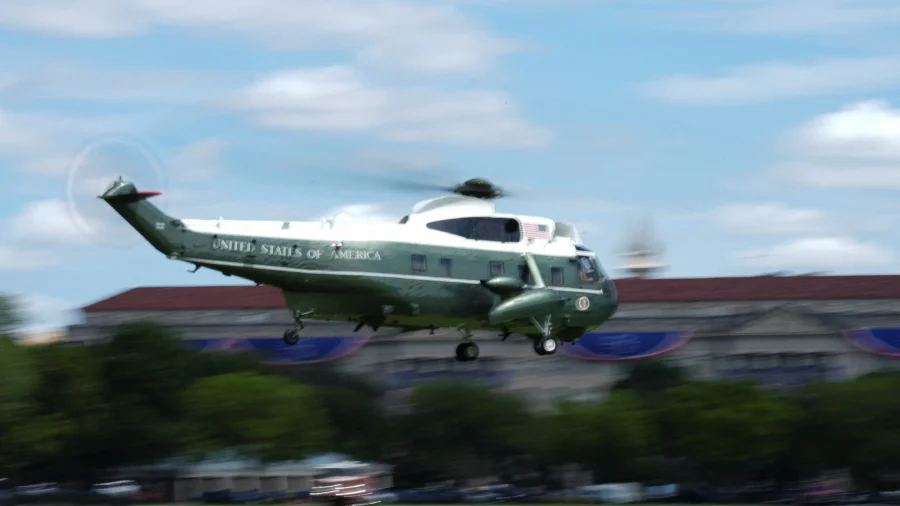
The Federal Aviation Administration (FAA) said on Aug. 4 that it is investigating an air-traffic safety incident in Washington involving Marine One, the helicopter used to carry President Donald Trump for short trips.
“The FAA is investigating a safety incident involving Marine One but it didn’t appear to be a dangerous close call and the aircraft weren’t apparently converging,” the regulator said in a statement to multiple news outlets.
The incident occurred on Aug. 4 after the helicopter departed the White House, when air-traffic controllers allegedly failed to halt commercial flights around Ronald Reagan Washington National Airport as required by safety procedures, according to multiple reports.
Marine One is typically used to take the president on short trips, mainly to the White House or Andrews Air Force Base.
The Epoch Times reached out to the FAA for more information but did not receive a response by publication time.
The FAA tightened rules for helicopter and aircraft operating near Ronald Reagan Washington National Airport after the Jan. 29, 2025, midair collision between a passenger jet and an Army helicopter that killed 67 people.
After the crash, the FAA barred mixed helicopter and jet traffic around the airport. When Marine One is in flight around the airport, commercial traffic is halted. The FAA had also barred the use of visual separation, a practice in which the pilots are responsible for maintaining separation from other aircraft through visual observation to ensure efficient traffic flow.
The American Airlines jet was flying a daily route from Kansas to the nation’s capital when it collided with the Black Hawk helicopter, which was on a training mission.
The NTSB said the FAA’s decision to permit helicopter traffic to operate so close to commercial aircraft operations created an unacceptable risk.
The NTSB also faulted the FAA for failing to adequately review data that indicated the risk of a midair collision within the airspace around the Potomac and for allowing air-traffic controllers to rely on “visual separation.”