


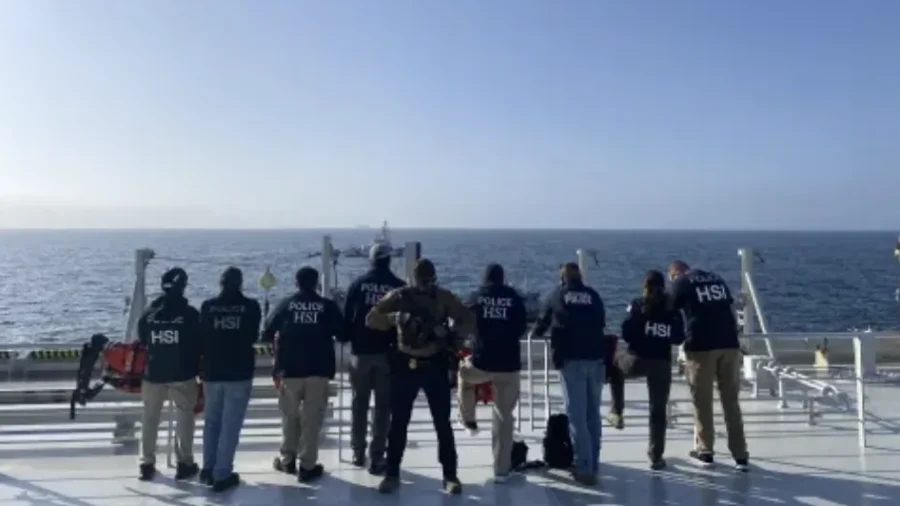
Federal agents seized 500 pounds of cocaine worth about $6.4 million from a crude oil tanker at the Port of Los Angeles on May 21, according to the Department of Homeland Security.
The bust came when a Coast Guard canine trained in narcotics detection was alerted to suspected contraband hidden somewhere aboard the boat. Investigators confirmed the find shortly after, and one person was arrested while two others were taken into custody.
"HSI's swift response and investigative expertise were instrumental in identifying and seizing over 226 kilograms of cocaine destined for our communities," said Eddy Wang, HSI Los Angeles Special Agent in Charge. "We remain dedicated to pursuing those who attempt to exploit our ports and transportation systems, and to working with our partners to disrupt criminal organizations that threaten public safety."
Coast Guard Sector Los Angeles-Long Beach Commander Capt. Stacey Crecy called the operation a model of interagency teamwork. "Through stellar coordination, we effectively detained the suspect and removed the contraband from the vessel to protect the maritime transportation system and facilitate commerce as quickly as possible," Crecy said.
The Port of Los Angeles bust is part of a broader surge in federal drug interdiction that has shattered records on both land and sea. According to DHS, HSI seized more than 917,000 pounds of cocaine in 2025 alone, while the Coast Guard topped 511,000 pounds—more than three times its annual average—largely driven by Operation Pacific Viper, a counter-narcotics campaign launched in August 2025.
The campaign reached a milestone in February when cumulative cocaine seizures under the operation surpassed 200,000 pounds. Most recently, in April, the Coast Guard Cutter Escanaba recovered more than 4,500 pounds of cocaine off the coast of Ecuador on Easter Sunday after a maritime patrol helicopter spotted a suspicious boat dumping contraband overboard.
Federal officials have said the pressure isn't letting up. The combined efforts of HSI and the Coast Guard have denied criminal organizations billions of dollars in illicit revenue, according to the Department of Homeland Security, while blocking a steady pipeline of narcotics from reaching American streets and communities.