


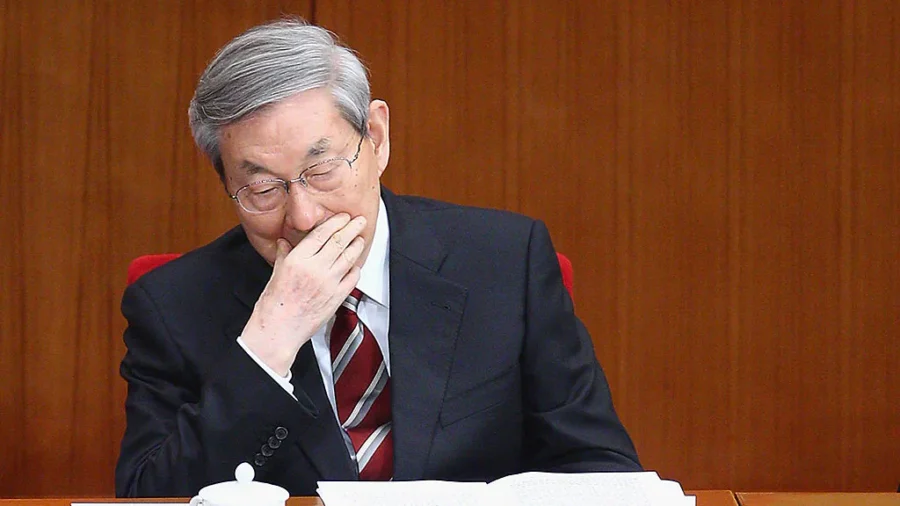
Former Chinese Premier Zhu Rongji passed away on Aug. 12 in Beijing at the age of 97.
Serving sequentially as vice premier and premier of the State Council of China between 1991 and 2003, Zhu Rongji was a deeply influential "economic iron fist" figure in China's reform and opening-up process.
The major reforms he spearheaded during his tenure laid the institutional foundation for China's rapid economic growth in the decades that followed, although his reforms also brought about high social costs and long-term problems.
He restructured the "tax-sharing system reform" between the central and local governments, substantially boosting central fiscal revenue. This provided the financial foundation for subsequent infrastructure development and macroeconomic regulation.
Overcoming resistance from domestic conservatives and vested interest groups, he successfully pushed for China's accession to the WTO in 2001, ushering in China's two-decade golden era as the "factory of the world" and driving explosive growth in foreign trade.
The April 25 Incident
While economic restructuring defined his official portfolio, Zhu was also known for his pragmatic handling of the incident on April 25, 1999.The incident, involving Falun Gong, was the largest collective popular petition under the communist system since the 1989 Tiananmen Square protests. Through Zhu's intervention, it briefly achieved a constructive interaction between officials and citizens.
Falun Gong, founded by Li Hongzhi in 1992, rapidly attracted a large number of practitioners due to its health benefits. However, as the number of practitioners surpassed the membership count of the Chinese Communist Party (CCP), the official and academic stance toward Falun Gong began to shift.
In mid-April, 45 practitioners were arrested in the city of Tianjin following their protest against a magazine article explicitly criticizing Falun Gong.
On April 25, over 10,000 Falun Gong practitioners gathered near the State Council Appeals Office in Beijing to petition.
That day, Zhu met with representatives of the Falun Gong practitioners and agreed to their requests: releasing the practitioners detained in Tianjin, providing a relatively relaxed environment for practice, and allowing the publication of related books.
However, despite the peaceful outcome on the surface, the event sent massive shockwaves through the CCP Central Politburo.
Jiang Zemin, then-general secretary of the CCP and leader of China, felt extreme shock and anxiety over thousands of people petitioning without advance warning.
On the evening of April 25, Jiang wrote a letter to the Politburo Standing Committee, emphasizing that the CCP must "defeat" Falun Gong.
Following this, the policy of Jiang and the CCP regime toward Falun Gong turned sharply coercive. In July of the same year, a ban on Falun Gong was officially announced, leading to the detention, persecution, and forced organ harvesting of countless practitioners—a campaign of persecution that continues to this day.