


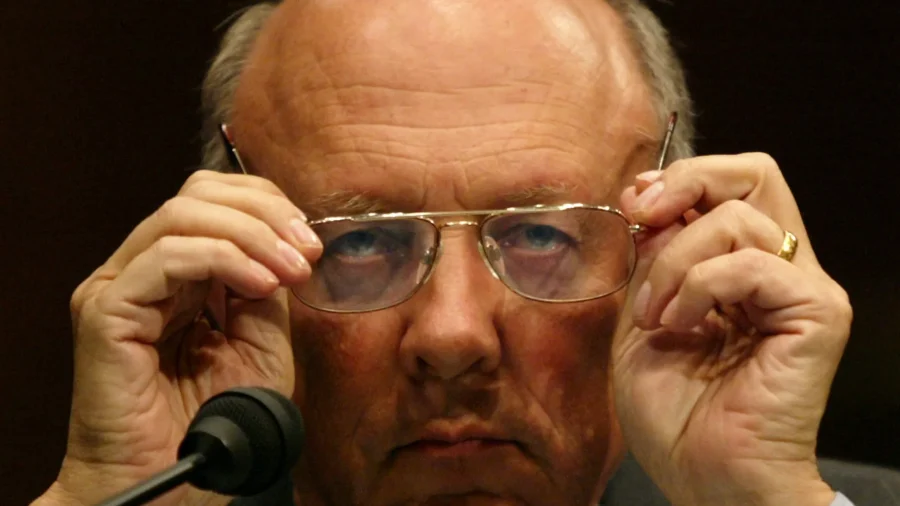
Former Central Intelligence Agency (CIA) Director R. James Woolsey, who led the nation's intelligence agency during the early years of the Clinton administration, has died after suffering a stroke. He was 84.
Woolsey died Tuesday at his home in Washington, according to his wife, Conchita Sarnoff Woolsey. She told The Washington Post that he died from a stroke and said his health had declined in recent years after developing what she described as Havana syndrome.
The CIA said Woolsey advocated for the agency during a period of budget uncertainty and upheaval at the end of the Cold War, working to preserve officer morale and strengthen ties between the intelligence community and law enforcement.
“That partnership continues to this day and has enabled some of our greatest successes,” the CIA said.
Woolsey served as director of central intelligence from 1993 to 1995 during former President Bill Clinton's first term. He oversaw both the CIA and the U.S. intelligence community during a period marked by post-Cold War restructuring and significant national security challenges.
His tenure included the fallout from the arrest of former CIA officer Aldrich Ames, who admitted spying for the Soviet Union and Russia for years. Ames, a career CIA officer, admitted being paid $2.5 million by Moscow for U.S. secrets from 1985 until his arrest in 1994.
Before leading the CIA, Woolsey served as undersecretary of the Navy during the Carter administration and later represented the United States in negotiations to reduce conventional military forces in Europe under President George H.W. Bush. Those talks culminated in the 1990 Conventional Armed Forces in Europe Treaty signed by Bush and Soviet leader Mikhail Gorbachev.
His wife said Woolsey's health deteriorated after experiencing Havana syndrome. She said the couple traveled extensively seeking treatment but never found an effective cure.
Woolsey was born in 1941 in Tulsa, Oklahoma. He graduated from Stanford University, studied as a Rhodes Scholar, and earned a law degree from Yale University before beginning a decades-long career in government, national security, and private law practice in Washington.