


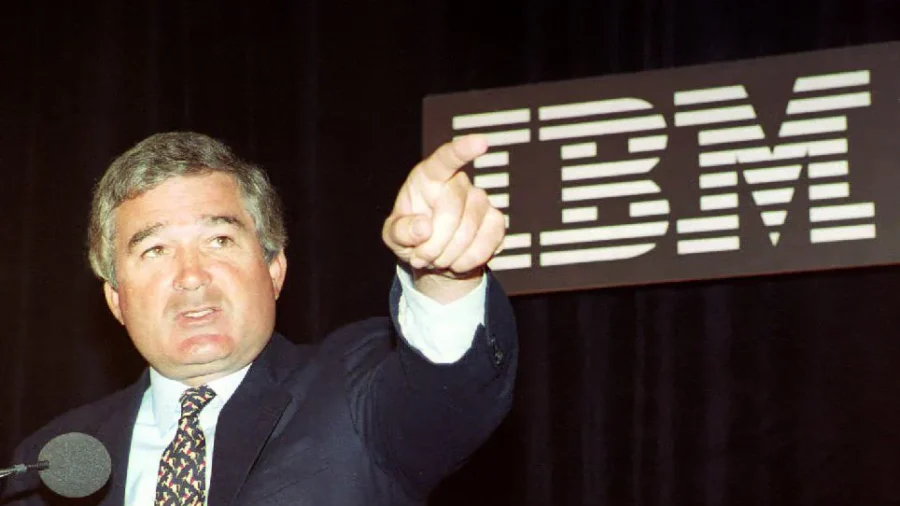
Gerstner, who led IBM from 1993 to 2002, took the helm when the technology giant was struggling with losses, internal fragmentation, and questions over whether it should be broken up.
His decision to keep the company together and refocus it on customers rather than internal processes reshaped IBM and influenced how large technology firms approached strategy in the decades that followed, according to a statement by IBM’s chairman and CEO, Arvind Krishna.
Krishna said Gerstner arrived at IBM “at a moment when the company’s future was genuinely uncertain,” as rapid industry change and internal pressures fueled debate over whether IBM could survive as a unified enterprise.
“His leadership during that period reshaped the company,” Krishna wrote, saying Gerstner focused “relentlessly on what our clients would need next.”
Shift Toward Customers
Krishna recalled one of Gerstner’s earliest moments as CEO, an episode that became emblematic of his management style. Early in his tenure, Gerstner halted a lengthy internal presentation and said, “Let’s just talk,” Krishna wrote.The remark, Krishna said, signaled a shift away from inward-looking discussions and toward direct conversations grounded in customer needs. That mindset, he added, defined Gerstner’s years at IBM.
One of Gerstner’s most consequential decisions was to keep IBM intact at a time when many believed it should be dismantled into separate businesses.
“Lou made what may have been the most consequential decision in IBM’s modern history: to keep IBM together,” Krishna said.
At the time, IBM’s various divisions often pursued their own paths, but Gerstner believed customers wanted integrated solutions rather than fragmented technology. That conviction, Krishna said, shaped IBM’s evolution and restored its standing with large enterprise clients.
Gerstner also believed strategy alone was insufficient without cultural change. Krishna said Gerstner emphasized how employees behaved when no one was watching and pushed IBM to renew its long-standing values rather than discard them.
Krishna said Gerstner remained engaged with IBM long after stepping down. From Krishna’s first days as CEO, Gerstner offered advice cautiously, often saying, “I’ve been gone a long time—I’m here if you need me.”
Career Beyond IBM
Gerstner’s influence extended well beyond IBM. Before joining the company, he had already built a prominent career, becoming one of the youngest partners at McKinsey & Company. He later served as president of American Express and as CEO of RJR Nabisco.After leaving IBM, Gerstner went on to chair The Carlyle Group and devoted significant time and resources to philanthropy, particularly in education and biomedical research, Krishna wrote.
A native of Long Island, New York, Gerstner earned his undergraduate degree from Dartmouth and an MBA from Harvard. He was preceded in death by his son, Louis Gerstner III.
The organization focuses on biomedical research, the environment, education, and direct assistance, areas described as being of personal importance to Gerstner and his family. Most grants are made in metropolitan New York, Boston, and Palm Beach County, Florida, where the family lives and works.
According to the foundation, Gerstner’s children assumed leadership roles in 1997 and helped expand its reach over the years.