


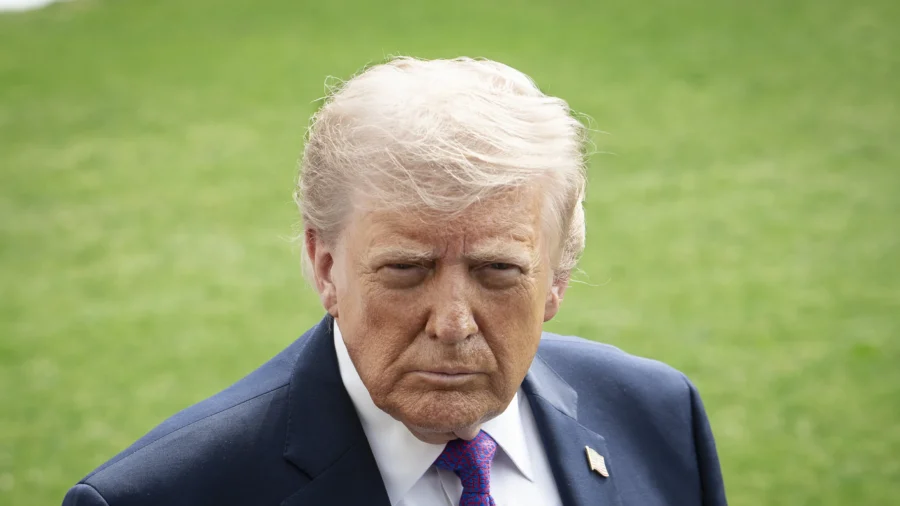
WASHINGTON—The United States launched retaliatory strikes against Iran on June 9 after President Donald Trump accused Iran of downing a U.S. attack helicopter a day earlier.
U.S. Central Command (CENTCOM) said in a statement its “forces began launching self-defense strikes against Iran at 5 p.m. ET today at the Commander in Chief’s direction, in response to yesterday’s downing of a U.S. Army Apache helicopter. The mission is a proportional response to unjustified Iranian aggression.”
“CENTCOM forces struck Iranian air defense, ground control stations, and surveillance radar sites near the Strait of Hormuz with precision munitions from U.S. Air Force and Navy fighter jets,” it said on X. “The operation was a proportional response to recent attacks on U.S. forces and international commercial ships transiting regional waters.
“U.S. forces remain vigilant and postured to defend against unjustified Iranian aggression,” it added.
Trump had earlier said Iran was responsible for downing the helicopter near the Strait of Hormuz, and vowed that the United States would respond.
"I have just been informed by our Great Military that last night the Iranians shot down one of our highly sophisticated Apache Helicopters while patrolling over the Strait of Hormuz," Trump said in a Truth Social post.
"There were two pilots involved, both are safe and uninjured. Nevertheless, the United States must, of necessity, respond to this attack."
“Should the aggressions and hostile acts continue—including in southern Lebanon—far more severe and crushing measures than before will be forthcoming,” Iran's military said in a statement carried by state-affiliated media on June 8.
Trump's vow to respond to the downing of the U.S. helicopter could further unsettle efforts to reach a peace agreement with Tehran. Hours earlier, Trump said negotiations were in their "final throes" and that he'd prefer diplomacy to further bloodshed.
“If we do the bombing, you know a lot of people are going to be killed. Who wants to do that? I don’t,” Trump told reporters in New York on Tuesday morning. “We’ll have a signed document that’s actually stronger than doing the bombing.”
House Speaker Mike Johnson (R-La.) said he received notification of the planned strikes before they took place.
On Tuesday, Johnson told reporters, he spent several hours in the situation room with Trump, Vice President JD Vance, Secretary of State Marco Rubio, Secretary of War Pete Hegseth, and the CIA director to discuss matters related to the ongoing military activity, including the renewal of Section 702 of the Foreign Intelligence Surveillance Act.
Johnson said the strikes on Iran were “targeted,” describing them as “defensive in nature.”
“We lament that [it] has become necessary,” he said, but described the U.S. attack as “proportional” to a strike by Iran on U.S. assets and personnel in the region.
“We can’t allow that,” Johnson said.
Iranian state media reported that the strikes hit Qeshm, an island in the Strait of Hormuz, and said another strike was confirmed in Sirik, an Iranian port city along the strait. According to the Mehr News Agency, explosions had been heard in nearby Bandar Abbas.
Iranian Foreign Minister Abbas Araghchi vowed that Iran would respond, writing in a post on X that the U.S. had “opted to test our determination.”
“Our Powerful Armed Forces will leave no attack or threat unanswered,” Aragchi wrote, warning foreigners to “leave our region if you want to be safe.”
A White House official told The Epoch Times that the president won't be rushed into concluding a bad deal with Tehran.
"President Trump holds the cards and has all the time he needs to make the best deal for the United States and the world," the White House official said.
Following Trump's vow of retaliation, Iranian Foreign Minister Abbas Araghchi said the Strait of Hormuz is a shared waterway of Iran and Oman, and outside forces are at risk by operating in that waterway.
Drone Boat Used in Rescue
Navy Capt. Timothy Hawkins, a CENTCOM spokesman spokesman, told The Epoch Times that a 24-foot Corsair unmanned surface vessel was the first to reach the flight crew of the downed Apache helicopter. The Corsair drone boat is assigned to Task Force 59, which manages the operation of unmanned systems in the Middle Eastern waterways.Hawkins said the Corsair drone boat transported the downed flight crew to another location, where a rescue helicopter arrived to collect them and provide further transport.
CENTCOM previously disclosed that the flight crew were safely rescued at 7:33 p.m. ET on Monday, around two hours after their helicopter went down.
Task Force 59 began fielding Corsair drone boats in late March, weeks after U.S. forces commenced combat operations against Iran.
Elements of the Army's 82nd Airborne Division and the Air Force were also involved in the rescue effort.