

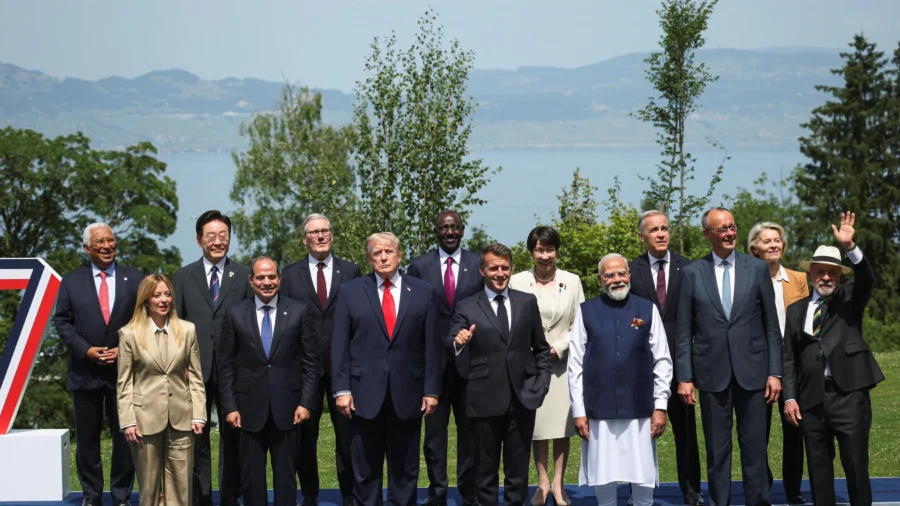
G7 leaders reaffirmed their opposition to unilateral force or coercion in the East and South China Seas and across the Taiwan Strait, in their June 17 geopolitical statement from the Évian summit.
The statement issued by the G7 leaders said that they “highlight the importance of a free and open Indo-Pacific based on the rule of law.”
“We reaffirm our opposition to any unilateral attempts to change the status quo, in particular by force or coercion, in the East and South China Seas and across the Taiwan Strait, which should only be resolved peacefully through dialogue,” the statement said.
Taiwan’s Foreign Ministry welcomed the statement, saying G7 members had again demonstrated concern for peace and stability across the Taiwan Strait.
Foreign Minister Lin Chia-lung expressed “sincere welcome and gratitude,” the ministry said in a statement. It said the G7’s support for peace and stability in the Taiwan Strait demonstrated that maintaining the status quo has become an international consensus.
Indo-Pacific
The Évian statement continues a pattern in recent G7 leader documents.At the 2023 Hiroshima summit, G7 leaders said they supported a free and open Indo-Pacific and opposed unilateral attempts to change the status quo by force or coercion.
The 2024 Apulia communiqué reaffirmed that peace and stability across the Taiwan Strait were “indispensable to international security and prosperity.” It also supported Taiwan’s meaningful participation in international organizations where statehood is not a prerequisite and said there was no change in G7 members’ basic positions on Taiwan, “including stated ‘One China’ policies.”
The 2025 Kananaskis chair’s summary said leaders discussed China’s activities in the East and South China Seas and the importance of maintaining peace and stability across the Taiwan Strait.
Regional Challenges
Japan’s Foreign Ministry said Prime Minister Sanae Takaichi attended the G7 working dinner on June 15 and explained Japan’s views on the Indo-Pacific and regional challenges, including those related to China.Those issues have “a significant impact on international peace, stability, and prosperity,” the foreign ministry said, adding that G7 leaders concurred on working together to address them.
Takaichi also raised critical minerals and supply-chain resilience during the dinner. She proposed a “Joint Stockpiling Cooperation Initiative” for critical minerals and called for accelerated diversification of supply sources with like-minded countries, according to Japan’s Foreign Ministry.
The statement by G7 leaders did not name China when referencing opposition to changes in the Taiwan Strait, but it did mention China in a separate paragraph on global economic imbalances.
The statement welcomed the Global Convergence for Growth Summit convened by French President Emmanuel Macron on June 11, “with the participation of China.” It said G7 leaders shared an interest in working with other large economies on the causes of “large and persistent global imbalances” and said those efforts would continue within the G20 under the United States’ host year and in other forums.
The G7 statement also expressed deep concern over North Korea’s nuclear and ballistic missile programs and reaffirmed support for the complete denuclearization of North Korea in accordance with U.N. Security Council resolutions.
The leaders urged North Korea to resolve the abductions issue immediately—a reference to Japanese citizens abducted by North Korean agents in the 1970s and 1980s—and said G7 members need to jointly address North Korea’s cryptocurrency thefts and cybercrimes.
Japan’s Foreign Ministry said Takaichi stressed the importance of North Korea’s complete denuclearization, expressed concern over North Korea’s nuclear and missile development, military buildup, and cryptocurrency theft, and thanked G7 leaders for their full support on the immediate resolution of the abductions issue.
Taiwan’s Foreign Ministry said Taiwan would continue to work with G7 members and global partners to ensure peace and stability in the region.