


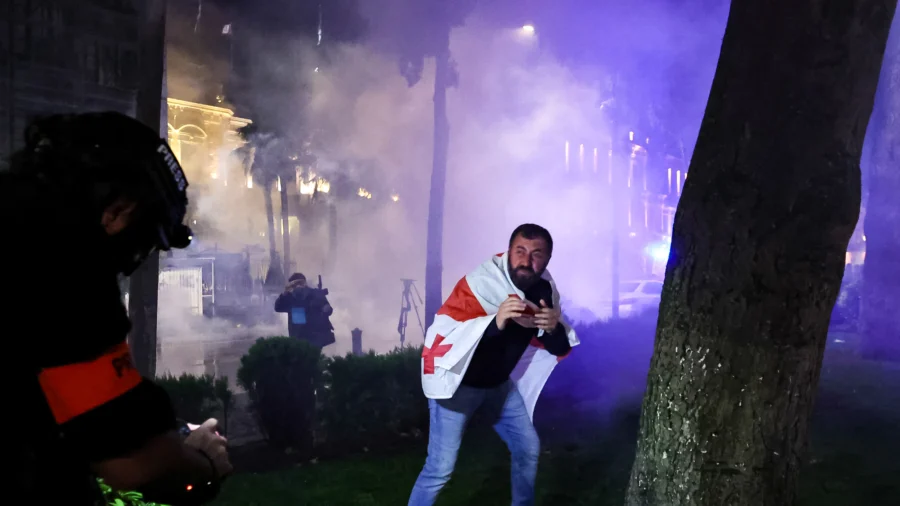
Georgian authorities foiled a foreign-backed coup, officials in the South Caucasus nation said, after local elections over the weekend were marred by raucous street demonstrations.
Georgians went to the polls on Oct. 4 to elect mayors and local council members in municipalities across the country, including the capital, Tbilisi.
The elections, which were boycotted by the country’s two main opposition blocs, were dominated by the ruling Georgian Dream party, whose candidates won in every municipality.
While polling was underway, thousands of Georgians opposed to the ruling party staged demonstrations in the capital, with opposition leaders pledging to wage a “peaceful revolution.”
Shortly before the polls closed, a group of protesters attempted to storm Tbilisi’s presidential palace before being pushed back by riot police wielding water cannons and pepper spray.
According to Georgia’s health ministry, 21 security personnel and six demonstrators sustained injuries in the melee.
Georgian Prime Minister Irakli Kobakhidze, speaking to reporters on Oct. 5, said the government had thwarted an attempted coup.
He also alleged that Brussels was backing the protests, accusing Paweł Herczynski, the EU’s ambassador to Georgia, of meddling in the country’s internal affairs.
“Specific people from abroad have even expressed direct support for … the announced attempt to overthrow the constitutional order,” the prime minister, a member of the ruling party, told local media.
“The EU ambassador to Georgia bears special responsibility. He should … condemn everything that is happening on the streets of Tbilisi.”
It also accused the Georgian Dream-led government of mounting an “extensive crackdown on dissent.”
“Raids on independent media, the passing of laws targeting civil society, the jailing of opponents … drastically reduced the possibility of having competitive elections,” the diplomatic service said in a statement issued on Oct. 5.
The next day, Georgia’s State Security Service said it had found a cache of arms and explosives on the outskirts of the capital that it said were intended for use in subversive acts.

Brewing Tensions
For more than a year, Georgia—a country of roughly 3.7 million people—has been rocked by intermittent protests, mainly in the capital.Demonstrators accuse the ruling party of adopting authoritarian tactics and seeking to align the country with Russia, allegations the party rejects.
Although the protest movement has dwindled in recent months, activists have continued to stage nightly rallies near central Tbilisi’s Rustaveli Avenue.
In October of last year, Georgian Dream won a comfortable victory in parliamentary polls that the opposition said were rigged in its favor.
The ruling party rejects the allegation, insisting that last year’s parliamentary polls were fair and reflected the popular will.
Georgian Dream says it seeks to steer a balanced course between the West and Russia and preserve what it calls Georgia’s traditional Orthodox Christian values.
Under the party, the country’s ties with the West have soured, with both Brussels and Washington accusing it of espousing anti-democratic practices.
Last year, Brussels suspended the country’s EU membership bid after Georgia’s parliament passed legislation that aims to restrict perceived foreign influence.