


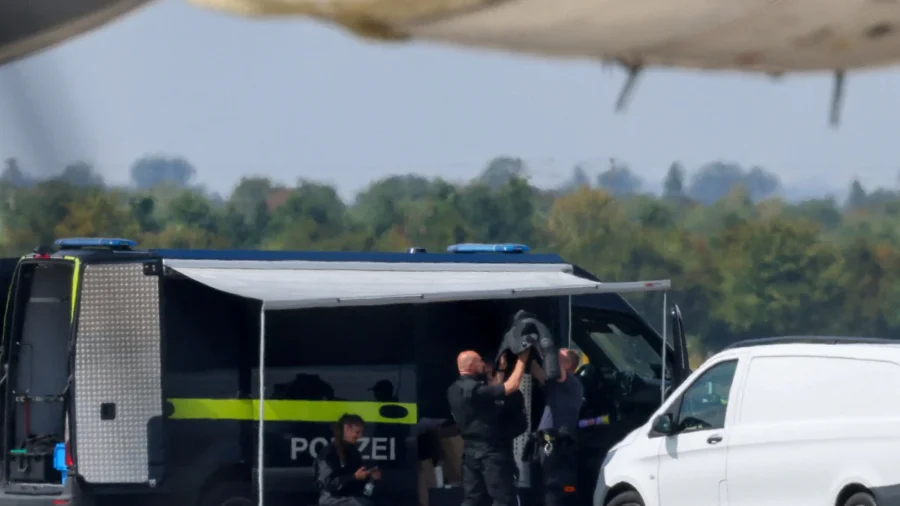
Germany is facing daily hybrid warfare attacks from foreign adversaries, a senior minister has said, following a suspected attempted drone attack on the Leipzig/Halle Airport last week.
Interior Minister Alexander Dobrindt told BILD on Aug. 8 that while he would not use the term “war” to describe the current situation, he believed that “the palpable strategic goal of foreign powers is to subjugate us politically and socially.”
“We are a daily target of hybrid warfare. Espionage, sabotage, cyberattacks, or covert operations by foreign powers aimed at destabilizing Germany or directly harming it are a constant reality,” Dobrindt told the German newspaper.
Dobrindt did not identify a particular country.
A hybrid attack falls short of an act of war and can include sabotage, propaganda, and other non-overt tactics.
The Federal Prosecutor’s Office said on Aug. 6 that “this constitutes a serious attack on the transport and logistics infrastructure in Germany.”
Leipzig/Halle Airport is a key cargo hub and military airport in the state of Saxony in eastern Germany.
It is the main base for NATO’s Strategic Airlift International Solution. Among other functions, it delivers equipment to strengthen the defense pact’s eastern flank, using a small fleet of Ukrainian-made Antonov cargo planes.
Dobrindt, at the time, described the incident as a “hybrid attack.”
While authorities have not identified any suspects, Dobrindt said he could not rule out “foreign powers.”
In the past, German lawmakers have blamed Russia for hybrid attacks—accusations that Moscow has repeatedly denied.
The Russian Embassy in Berlin on Aug. 7 dismissed the incident, denying that Moscow was involved in any hybrid attacks.
Drones Spotted Over Military Base
Days after the airport incident, German authorities said that two drones were spotted over a military base in the western part of the country.A spokesperson for the German armed forces, the Bundeswehr, said the unmanned aerial vehicles (UAVs) were sighted at around 10 p.m. local time on Aug. 6 at the base in Mechernich in the state of North Rhine-Westphalia, some 22 miles from the border with Belgium.
UAVs operating close to the European border, however, had resulted in vehicles unintentionally straying into NATO territory.
Romania, a NATO member, shares a 400-mile land border with Ukraine, and Russian UAVs have repeatedly violated its airspace during the more than four-year war.
Lipaev dismissed the alleged Russian violations of Romanian airspace, protesting what he said was an “unjustified expulsion” of an embassy employee.