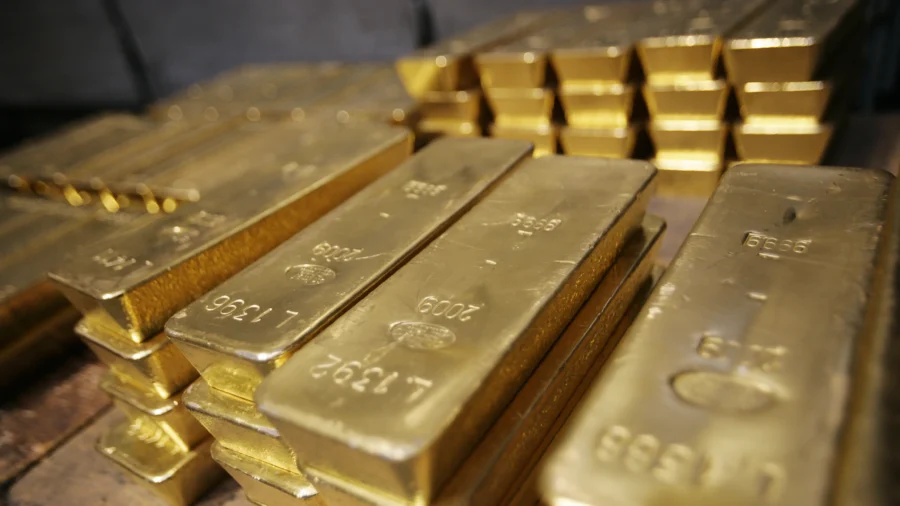
Gold soared to a new milestone Tuesday, reaching a record high of $3,500 per ounce in overnight trading before coming back down, as investors flock to the safe-haven asset amid escalating global economic uncertainty, according to data from the U.S. futures market (COMEX).
The precious metal’s rally comes on the heels of a turbulent period for financial markets, marked by intensifying trade tensions, a weakening U.S. dollar, and mounting concerns over central bank independence. Spot gold prices had
already broken the $3,400 barrier Monday morning, climbing to $3,424.40 per ounce as a combination of risks drove demand for the metal.
The Trump administration’s
recent imposition of up to 245 percent tariffs on Chinese goods and 25 percent tariffs on all imports from Mexico and Canada has brought fears of a prolonged global trade conflict. In retaliation, Beijing slapped 125 percent levies on U.S. products, further escalating the standoff between the world’s two largest economies.
White House press secretary Karoline Leavitt
told reporters Tuesday that President Donald Trump remains optimistic about a potential trade deal with China, stating the administration is “doing very well” and “moving in the right direction” toward an agreement.
Treasury Secretary Scott Bessent echoed this sentiment, suggesting during a closed-door event that both sides could de-escalate tensions in the “very near future.”
Despite reassurances from officials, the uncertainty surrounding tariffs and trade negotiations has rattled financial markets. “The market is still fraught with uncertainty over tariffs and trade, and the potential impact on inflation and the broader economy,” said Greg McBride, chief financial analyst at Bankrate.
A weakening U.S. dollar has further boosted gold’s appeal, making the metal cheaper for foreign buyers and driving up demand. The U.S. dollar index has been on a downward trajectory since mid-January, recently hitting a
three-year low.
Moreover, gold notably was
exempt from the April 2 list of reciprocal tariffs.
Investor Demand and Institutional Moves
As investor appetite for gold surges, the World Gold Council
reports $8.6 billion in global inflows into physically backed gold exchange-traded funds in March. North America accounted for 76 percent of these inflows, investing $6.5 billion, as investors sought refuge from equity pullbacks and market liquidity concerns.
UBS, a leading investment firm, recently raised its gold price target to $3,500 per ounce, citing a “perfect storm of factors like escalating geopolitical tensions, fears of inflation, and a shifting interest rate outlook—the combination of which has driven stronger-than-expected demand from ETFs and speculators,” according to an April 11
post. The firm also noted a structural shift in gold allocations, with Beijing allowing insurance funds to invest in gold and central banks systematically increasing their gold reserves.
Yvonne Blaszczyk, CEO of BMG Group, projected an even more bullish outlook, predicting gold could reach $4,000 per ounce by year’s end. “Gold is going to go up in value, the price is going to rise dramatically, and it will continue [to] rise for [a] variety of reasons,” she said.
Market Reaction
The surge in gold prices coincides with a rebound in U.S. equities, as optimism over potential trade negotiations lifted stocks. The Dow Jones Industrial Average
jumped about 1,000 points, while the S&P 500 and Nasdaq Composite each advanced more than 2 percent. Shares of companies with strong ties to China, including Nvidia and AMD, also posted large gains.
However, not all commodities have benefited from the current climate. Brent Crude Oil futures have declined nearly 6 percent since early April, trading at $68.14 per barrel Monday evening, as the prospect of increased supply and global tariff concerns weighed on prices.