


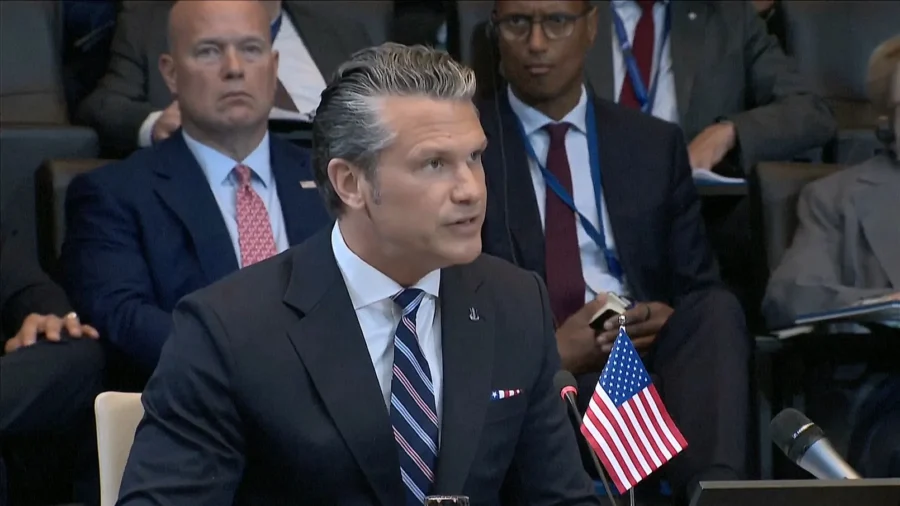
Speaking at a NATO meeting with the alliance's defense ministers in Brussels on Thursday, Hegseth claimed that NATO has been a "paper tiger" and "one-way street" for too long and that the review is necessary to hold them accountable.
"This will be a real review,” Hegseth said at a NATO meeting with the alliance's defense ministers in Brussels on Thursday. “It will be designed to ensure that NATO is moving fast and irreversibly towards Europe stepping up to take primary responsibility for the defense of Europe."
Hegseth warned that if allies don't step up, the United States may reduce its own annual financial contributions to NATO, adding that “some countries will fail, and others will pass with flying colors.”
The Pentagon chief has previously pressed allies to raise defense spending, setting a target of 3.5 percent of GDP as part of a broader push for greater burden-sharing.
Europe has since grappled with concerns over statements from Trump administration officials about scaling back American troops and military assets. The Trump administration recently announced that it would no longer provide as much military support should any NATO member come under attack.
NATO Secretary-General Mark Rutte said he has been preparing backup defense plans for Europe after the United States signaled that it would withdraw commitments to provide an aircraft carrier, support vessels, refueling aircraft and dozens of fighter jets during a crisis.
Rutte noted that any of those changes would not happen immediately.
“This is not about where forces and assets are currently located,” he said on the eve of the NATO defense ministers meeting. “It’s about who would do what if our defense plans were activated. So, let’s say in case of an Article 5 situation."
Under NATO’s Article 5 collective defense pledge, the alliance’s 32 members agree that an attack against one ally is treated as an attack against all. However, the provision does not require members to provide military forces, even though many are expected to respond with support.
Back in April, President Donald Trump, during a closed-door meeting with Rutte, expressed frustration with NATO allies over what he perceived as a lack of support over the Iran war.
Trump had even suggested the U.S. may consider leaving the trans-Atlantic alliance after NATO member nations ignored his calls for support after Iran effectively shut down the Strait of Hormuz, ultimately causing gas prices to soar.