


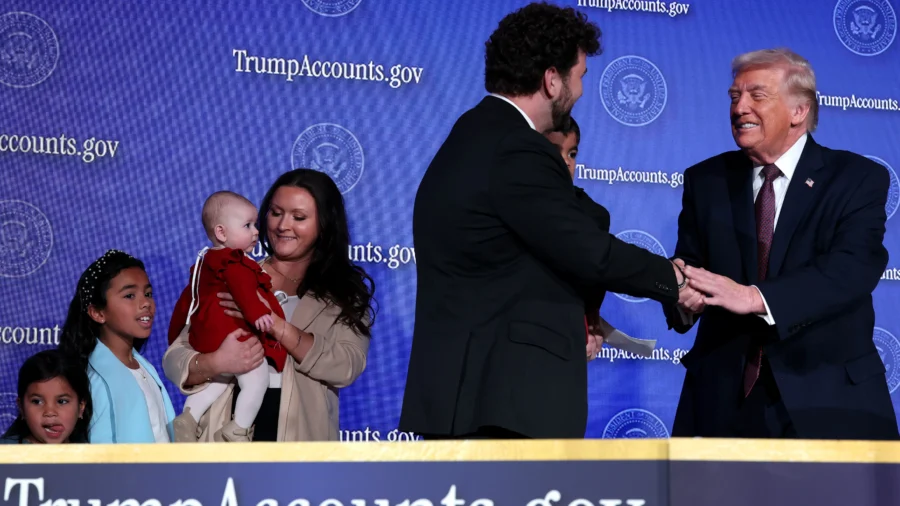
Trump accounts are on the way, with a July 4 launch date, as every American born between 2025 and 2028 automatically receives an account with $1,000 from the U.S. Treasury that will be invested in a low-cost index fund.
The funds will be the sole property of the child and won’t be accessible until the child turns 18, at which point the funds transition to a regular IRA. Under plan rules, Trump accounts can accept up to $5,000 in additional contributions annually, with up to $2,500 in contributions allowed on a tax-free basis by the parents’ employer.
What are Trump Accounts, and why should parents use them?
A Trump Account is a tax-advantaged investment account for kids that was created under Section 530A of the tax code. Any eligible U.S. child under 18 can have one.“On top of that, every U.S. citizen child born between Jan. 1, 2025, and Dec. 31, 2028, also gets a one-time $1,000 deposit from the government,” David Fortune, co-founder of child-focused micro-investing app SuperMoney, told NTD News. “The money sits in low-cost U.S. equity index funds, grows tax-deferred, and when the child is an adult, qualified withdrawals get taxed at long-term capital gains rates rather than ordinary income.”
Open the fund early
Opening the fund right away is highly advisable, Fortune said.Here’s how much the child can earn
Handled properly, a Trump Account can help funds stack up quickly.“One example in my analysis assumes a $1,000 initial contribution plus $3,000 per year until age 18, earning an 8 percent annual return,” Adam Bergman, founder of IRA Financial, told NTD. That account could grow to roughly $110,000 by age 18, and if it were then left alone and continued compounding at the same rate, it could approach $3 million by age 60, illustrating how relatively modest early contributions can translate into significant retirement wealth over time.”
Here's how families can sign up for or get started with Trump Accounts
Treasury and the IRS are running the Trump Account July 4 rollout, and once it's live, families will be able to open one through approved financial institutions: banks, brokerages, and the platforms that specialize in tax-advantaged kid accounts.Structurally, there are some similarities with Social Security accounts
Both the Trump Accounts and Social Security are government-initiated mechanisms for long-term financial security.“Social Security collects payroll taxes and pays them back out in retirement,” Bergman said. “A Trump Account seeds a kid's investment account and lets the market compound it.”
That said, they're not the same thing.
“Social Security is pay-as-you-go: today's workers fund today's retirees, and there's no individual account sitting in your name with assets in it,” Bergman noted. “A Trump Account is individually owned, it's invested in U.S. equities, and it goes up or down with the market. That's market risk Social Security doesn't have, and it's also market upside Social Security can't give you.”
Yet here’s where the comparison grows tighter.
“If you take a Trump Account, leave it invested in a broad U.S. equity index, and don't touch it for decades, you're building a private wealth layer that sits alongside Social Security,” Bergman added. “And whether the program gets expanded beyond the 2025 to 2028 birth window is going to determine how meaningful that layer actually becomes for American families. That's the policy conversation I'd want to see happening right now.”