


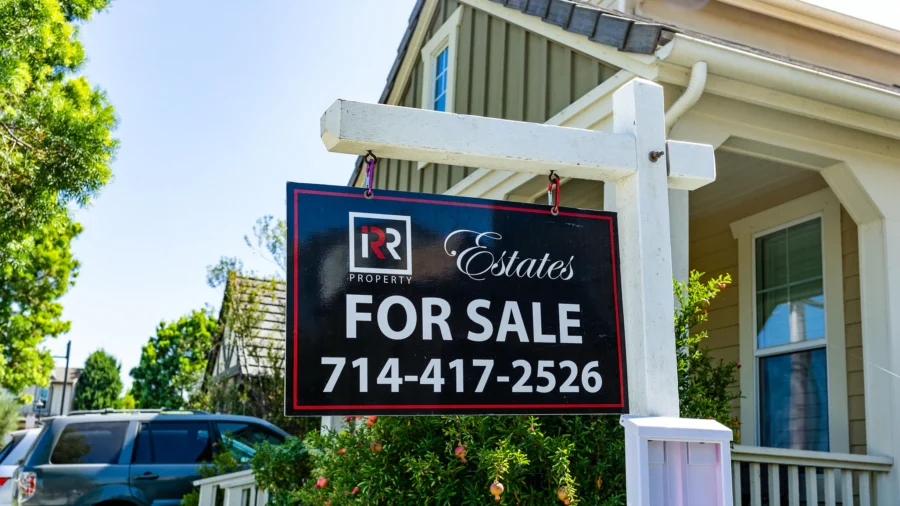
U.S. home sellers who can’t seem to close a deal have a tough decision to make, and the stakes couldn’t be higher.
Real estate professionals call that the “four-week rule.” That’s when a for-sale home is still on the market after that time period; it’s time to change strategies, and like the home’s sale price, too.
Now, a new Realtor.com study affirms the power of the four-week rule, at a time when the average American home is currently selling below its asking price. Realtor.com calls that “a sharp U-turn from the pandemic frenzy of 2021 and 2022.”
According the organization’s study, U.S. homes that sell at or before the four-week mark sell for +1.8 percent, while homes sitting at 18 weeks close -1.3 percent below the seller’s expectations.
Here's how to win the four-week sales battle
Home sales professionals have a different title for the four-week issue; they call it the $15,000 problem.“Overpricing is costing sellers real money,” Trey Langford, founder of Build Idaho, told NTD News.
When a home is priced right and sells within the first 5 days, sellers average $3,000 over the asking price. Yet by day six, that flips: sellers are already fielding offers $7,500 under the asking price. ”Wait until day 30, and the average offer is $12,000 below asking,” Langford noted. “The data is clear—pricing correctly out of the gate beats 'testing the market' every time, and testing is expensive.”
Start by tracking the red flags
Usually with the four-week rule, there are one or two clear signs that a for-sale home is listed too high, even if the seller won't admit it.Two signs stand out to Langford. First, a mismatch between online traffic and real-world action can be trouble: the listing gets plenty of views and saves but few actual showings because buyers are pricing it out before they ever walk through the door. Second, showings happen, but no offers follow, or the same objection about price comes back from multiple buyers' agents. “When both signs show up in the first two weeks, that's the market telling you the number is wrong, before the seller is ready to hear it,” Lanford noted.
Another stark warning is a for-sale property with high online traffic, yet experiences no-shows when showing the home in person. “If you have 2,000 views on Zillow and two walkthroughs, your marketing strategy is good; but your pricing strategy is working against you,” Greg Field, a solar home realtor at HomeSmart Realty Pros, told NTD.
There’s likely a need for an adjustment drop by day 14
Field believes sellers should get aggressive and forget the month-long wait, as the four-week rule is a death sentence.Don’t make timid reductions on a house price
Cutting corners on a price discount likely won’t move the house into "sold" territoryAgents play a big role in home sale price adjustment decisions
Real estate agents, buyers and seller agents alike, should get involved and work with a homeowner to lower their price when necessary.“Listing agents have the responsibility of being the expert for their sellers,” Daniel Abreu, founder of southwest Florida-based Abreu Group, a part of Realty One Group MVP, told NTD. “They should be able to provide factual data to show a proper pricing strategy.
Homebuyers Have Negotiating Leverage in ‘Four Week’ Scenarios
While important, buyer leverage typically depends on local real estate market conditions. “If there’s an absorption rate issue, and a property is sitting for a longer period of time, then price is not the issue,” Abreu said. “Sellers may have to be willing to negotiate more in those instances to get the property sold.”If inventory is high, buyers will have a clear advantage. For example, right now in Abreu’s market, sellers are discounting an average of 3-4 percent from the list price, and many times there are concessions thrown in to close a deal.
“Few markets still have lower inventory, where sellers may have some negotiating power, but nowhere near the leverage they had 4-5 years ago,” Abreu added.
For sellers, that means keeping a sharp eye on the home sales market and the calendar.