


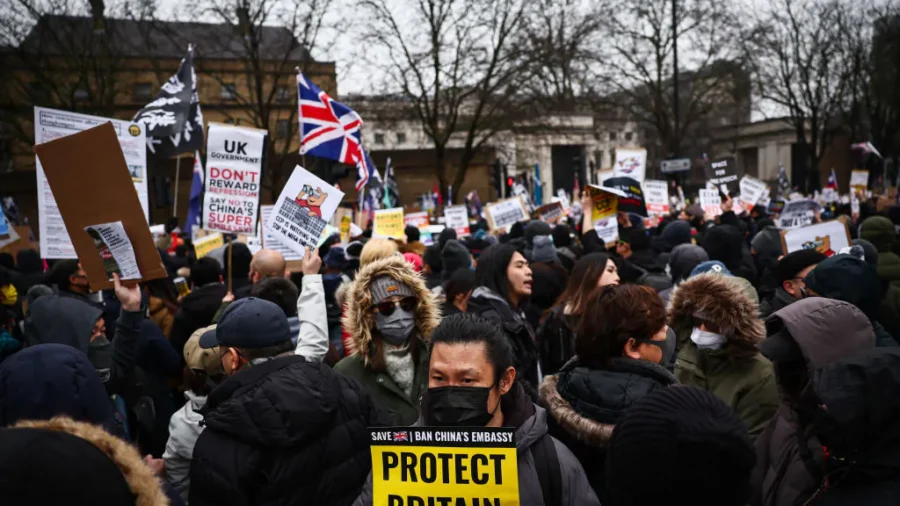
A hidden camera has been discovered inside the Whitehall government complex, the very site where plans for China’s controversial new “super-embassy” in London had been worked on and ultimately approved.
The revelation has intensified concerns that the UK government’s decision to greenlight the massive Chinese embassy project has exposed Britain to significant security risks.
According to multiple UK media reports, it remains unclear how or when the camera was installed. It was found within the past two months during a security sweep.
Ministers have been briefed that security officials discovered the concealed camera hidden in a ceiling panel at Marsham Street in Victoria, central London. The building houses key departments including the Home Office and the Ministry of Housing, Communities and Local Government (MHCLG).
NTD has contacted the MHCLG for comment.
While there is currently no evidence linking China to the device, the unsettling discovery has reignited intense concerns over espionage risks tied to Beijing's proposed super-embassy in London.
Housing Secretary Steve Reed approved the Chinese regime's plans in January, despite repeated warnings and intense criticism over potential national security threats.
The new Chinese embassy is located at the former Royal Mint Court site in London, right next to the City of London financial district. The area is home to numerous undersea fiber-optic communication cables and major data centers that carry highly sensitive information belonging to British financial institutions, corporations, and government agencies.
However, a UK government spokesperson said that intelligence agencies have thoroughly vetted the process to ensure national security remains the absolute priority, while Prime Minister Keir Starmer defended the decision.
The move concludes a fight that began in 2018 when Beijing first submitted its application. While the local Tower Hamlets council originally blocked the planning permission, Starmer called in the case for government review in 2024 following a request from Chinese leader Xi Jinping.
Downing Street insisted on Tuesday that its position on the controversial Chinese super-embassy had not changed despite the discovery of the hidden camera.
The prime minister’s spokesman said: “Our position on the Chinese embassy is a matter of public record. On this you’ve got the response from the department. I’d just point you back to that.”
However, the revelation has raised fresh doubts among opposition politicians.
As reported by The Telegraph, Alex Burghart, the shadow chancellor of the Duchy of Lancaster, said: “This is an extremely serious incident that demands an urgent investigation.
“The discovery of a hidden camera inside a building that occupies the Home Office and other departments raises serious questions about the security of government departments and the actions of those seeking to undermine them,” he said.