


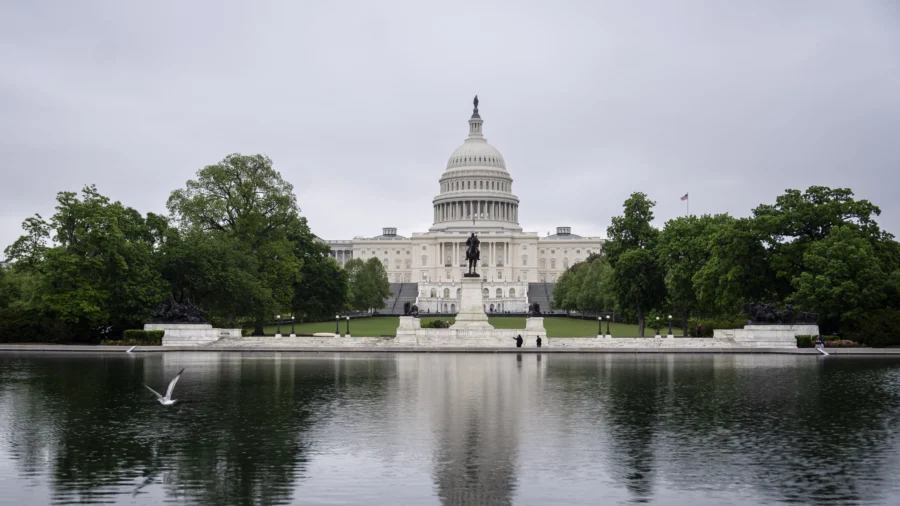
The House of Representatives approved a sweeping Farm Bill on April 30, sending it to the Senate for consideration.
The bill, which typically sets U.S. agricultural, nutrition, and conservation policy for roughly five years, passed the House in a vote of 224–200. The number in favor comprised 209 Republicans, 14 Democrats, and an independent, Rep. Kevin Kiley (I-Calif.), while 197 Democrats and three Republicans voted against it.
Lawmakers adopted several amendments, including one from Rep. Anna Paulina Luna (R-Fla.) that would block states from imposing pesticide labeling requirements that differ from federal standards set by the Environmental Protection Agency. That amendment passed 280–142, with support from 207 Democrats and 73 Republicans. Opposing it were 135 Republicans, six Democrats, and Kiley.
The legislation also includes a provision banning the creation of a central bank digital currency, a priority for many conservatives. However, Senate Republican Leader John Thune (R-S.D.) indicated that the measure is unlikely to survive in the Senate, where Democrats oppose it.
At its core, the bill directs funding and resources to farmers, ranchers, and producers to address environmental and resource challenges, including soil health, water quality, erosion, and wildlife habitat.
It maintains and strengthens conservation initiatives such as the Environmental Quality Incentives Program and the Conservation Stewardship Program, while promoting precision agriculture.
The package also introduces reforms to conservation easements and establishes a new Forest Conservation Easement Program aimed at protecting working forest lands.
Congress has not reauthorized the Farm Bill since 2018, although it was due for renewal in 2023. Republicans have argued that the update is urgently needed as farmers face rising production costs, increased bankruptcies, and broader economic uncertainty.
“Producers are currently facing some of the toughest times in farm economy since the 1980s farm crisis,” House Agriculture Committee Chair G.T. Thompson (R-Pa.) said during a Rules Committee hearing earlier this week. “And the simple fact is that the 2018 policies are no match for 2026 challenges.”
The bill’s path to passage was initially uncertain because of disagreements among Midwest Republicans over ethanol policy. Some lawmakers pushed for an amendment allowing—although not requiring—year-round nationwide sales of gasoline blended with 15 percent ethanol, known as E15. That fuel blend is typically restricted during the summer months because of smog concerns, although the Trump administration has issued temporary waivers to ease prices.
The Environmental Protection Agency has allowed expanded E15 sales since late March using emergency authority. Gas prices have climbed amid a global energy supply crunch, in part linked to the war with Iran and disruptions in the Strait of Hormuz. U.S. gas prices surpassed $4 per gallon in early April.
Ultimately, House leaders opted to remove the ethanol provision from the bill and instead hold a separate vote, clearing the way for the Farm Bill's final passage.