


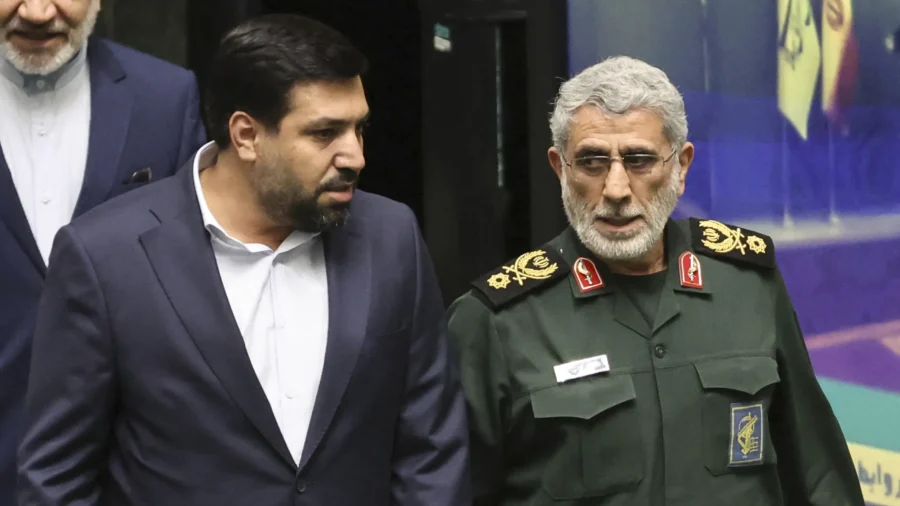
An Iranian regime intelligence official has warned that Iran would attempt to block shipping traffic in another waterway if the Israeli military continues to launch strikes against Hezbollah or in Gaza.
Esmail Qaani, the head of the Iranian Quds Force, an intelligence agency under the Islamic Revolutionary Guard Corps (IRGC), claimed that Iran would attempt to close the Bab al-Mandab Strait, which would echo Iran's move to effectively block traffic in the Strait of Hormuz since hostilities started.
Qaani referred to fighting between Israel and Hezbollah, a Lebanese terrorist group backed by Iran, and said that fighting in Lebanon and Gaza will "trap" Israel in a "whirlpool of Hezbollah’s operations and a new storm of Palestinian fighters," according to a report by state-run PressTV published on June 2.
Israeli actions in the region "would also prompt efforts to activate other fronts and to make the traffic situation in the Bab el-Mandeb Strait similar to that in the Strait of Hormuz," said state-run Tasnim News, paraphrasing Qaani.
Tensions in the Middle East escalated over the past weekend after Israel and Hezbollah launched strikes on each other, and also as the United States and Iran launched strikes amid a tenuous ceasefire.
U.S. Secretary of State Marco Rubio told lawmakers on June 2 that Iran had agreed to negotiate aspects of its nuclear program that it previously had refused to discuss, but added that this did not guarantee that negotiations would lead to a deal.
Rubio, who also serves as Trump's national security adviser, said the first condition in the talks was that Iran open the Strait of Hormuz, and also commit to negotiations on its stock of highly enriched uranium.
While speaking to CNBC on Monday, Trump said that oil and gas prices would decline soon, although he did not provide a reason.
“I think the oil will be dropping like a rock in the very near, you know, the very near distance,” Trump told the news outlet. He said that Americans who understand that Iran cannot obtain a nuclear weapon—a demand that he has given to the Iranian regime—are “willing to pay a little bit more” for gasoline as prices have remained elevated since the start of the conflict in February.
Trump has said that stopping Iran from acquiring nuclear weapons was his top priority. Iran has always denied wanting to build a nuclear bomb, saying its atomic facilities are for peaceful purposes only.
The Quds Force is a branch of the IRGC responsible for Iran's military intelligence and operations outside its country.
Previously, Trump ordered airstrikes that killed its former leader, Qassem Soleimani, in early 2020.