


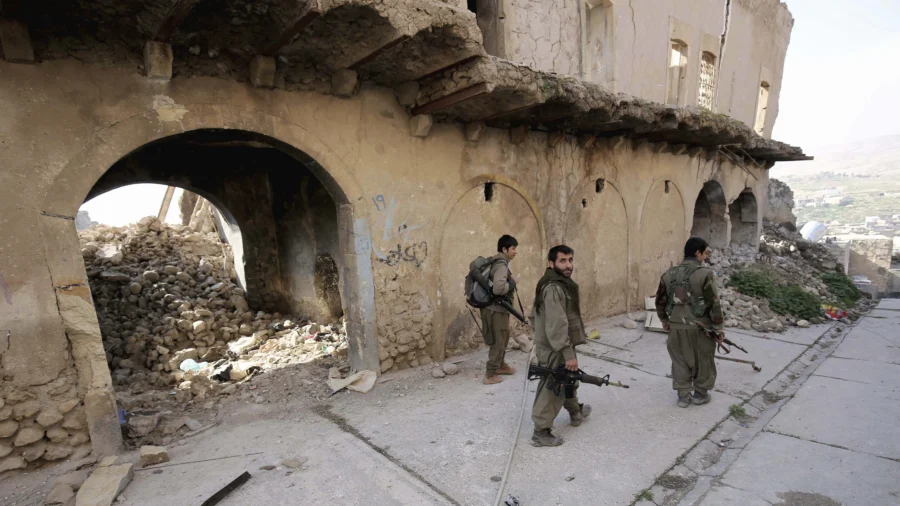
Thirty Kurdistan Workers Party (PKK) fighters laid down—and destroyed—their weapons in a symbolic disarmament ceremony on July 11 in the city of Sulaymaniyah in northern Iraq’s Kurdish region.
“We’ve had a hundred years of armed conflict, but we believe Kurdish issues should be resolved through democratic means,” said Turk, who helped mediate talks between Ankara and the PKK.
Erbil is the capital of northern Iraq’s semi-autonomous Kurdish region. Sulaymaniyah, which sits near the Iranian border, is the Kurdish region’s second-largest city.
Since the 1980s, the PKK has waged a violent campaign against the Turkish state in which tens of thousands of people—civilian and military—have been killed.
Turkey, along with the United States and the European Union, has long viewed the PKK as a terrorist group.
In a sign of the event’s regional significance, Iraqi and Turkish intelligence officials also attended the disarmament ceremony, Rudaw reported.
Ziryan Rojhelati, director of Rudaw Research Center in Erbil, called the event a “symbolic first step” toward the PKK’s eventual total disarmament.
“It’s a very sensitive process,” he told The Epoch Times, noting that PKK fighters who laid down their arms “won’t go back to Turkey tomorrow.”
‘Historic Turning Point’
In February, Abdullah Ocalan, the PKK’s long-imprisoned leader, issued a landmark appeal to PKK fighters—in both Iraq and Syria—to lay down their arms.Three months later, the PKK leadership, which has long been based in the mountains of northern Iraq, announced its decision to abide by Ocalan’s peace call.
In a video message released July 9, Ocalan declared that the decades-long “armed struggle” against Turkey must now give way to a “phase of democratic politics and law.”
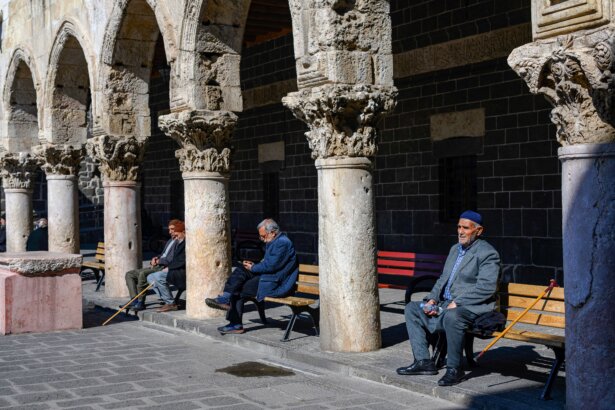
In return for disarmament, the PKK, along with the DEM Party, expects Ankara to implement a reform program aimed at advancing Kurdish political rights.
The DEM Party played a key role in the disarmament process by mediating between Ocalan, the PKK’s Iraq-based leadership, and the Turkish authorities.
Rojhelati said the success of the disarmament process will ultimately depend on “what happens in the short term regarding the amendment of Turkish legislation pertaining to the Kurdish question.”
“Without resolving longstanding [Kurdish] grievances, the possible resumption of conflict will remain a risk,” he noted, adding that Turkish officials appear to have “recognized this reality.”
“The PKK may disarm in line with its leader’s directive, but the Kurdish question must be resolved in the long term, including institutional changes [in Turkey].”
Ocalan founded the PKK in 1978 with the stated aim of establishing a Kurdish state in the Middle East. The group later moderated its stance, demanding Kurdish autonomy in southeastern Turkey, where ethnic Kurds predominate.
Despite his lengthy imprisonment, Ocalan is still widely regarded as the PKK’s de facto leader.
Turkey, Iraq, and Iran—along with the European Union and the United States—have all welcomed the PKK’s stated pledge to disarm, with Turkish President Recep Tayyip Erdogan describing it as a “historic opportunity.”
‘Terror-Free Turkey’
According to Aydin Sezer, an independent Turkish political analyst, the PKK issue has remained Turkey’s “most important problem for a very long time.”“Not only in terms of losses of soldiers to terrorism, but it also caused great damage to the Turkish economy,” Sezer told The Epoch Times.
“Turkey is now on the verge of resolving this issue,” he said, noting that “two key players”—Ocalan and Devlet Bahceli, head of Turkey’s Nationalist Movement Party—were “not only supporting the process, but guiding it.”
Bahceli, Erdogan's close ally, has been a leading proponent of the initiative from the outset, despite his longstanding—and well-known—antipathy toward the PKK.
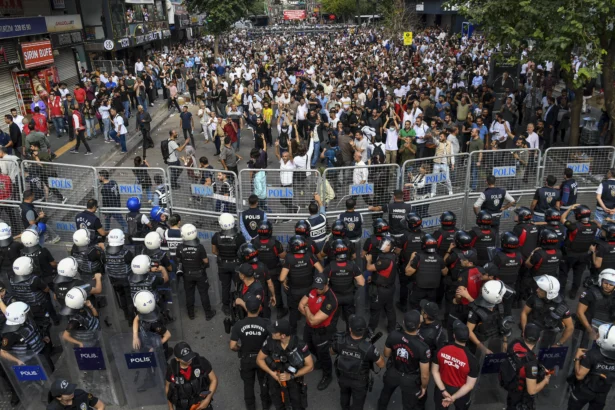
Ankara, meanwhile, is framing the process as a campaign to ensure a “terror-free Turkey” rather than a “peace process” between former adversaries.
Rojhelati warned that Turkish attempts to portray the disarmament process as the final “defeat” of the PKK would likely cause the initiative to fail.
“You cannot have peace with an organization like the PKK by claiming to have defeated it,” he noted, adding that Turkey must also make concessions.
“The ultimate success of the process will depend on how Turkey responds. I’m optimistic but cautious. We have to see what happens.”
On July 9, Omer Celik, spokesman for Erdogan’s ruling Justice and Development Party, or AK Party, said the PKK disarmament process would likely take “three to five months” to complete.
“If it exceeds this period, it will become vulnerable to provocations,” he said in televised comments, adding that Turkish military and intelligence officials were overseeing the disarmament process.
Sezer did not rule out the possibility that “groups within the PKK or certain intelligence services” might stage “provocations” in an effort to derail the nascent peace push.
War Weary
In any event, the PKK’s disarmament and eventual dissolution—if carried out—will have far-reaching implications for the region, according to Sezer.For one, he said, the PKK will now be expected to “vacate” its primary base of operations in northern Iraq’s Qandil Mountain region.
“Iraq is, of course, different,” Sezer said. “There’s an established structure in northern Iraq."
However, he said, “when it comes to Syria, [Kurdish] expectations are high” and “there is an expectation among [Syrian] Kurds for at least cultural autonomy."
“The United States and Turkey want the Kurds to be integrated into the new Syrian state, along with all their institutions,” he said, noting that “this remains unclear.”
“We have to see the extent of Ocalan’s influence on Syrian Kurds.”
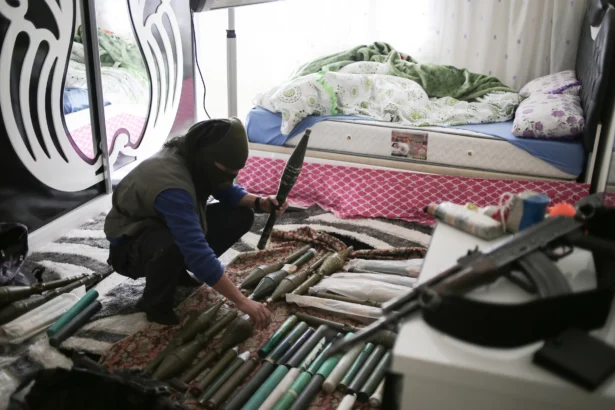
The initiative appears to enjoy significant support among both Turks and the region’s Kurds, many of whom say they are tired of the region's ongoing conflicts.
“Many Kurds no longer support the [PKK’s] guerrilla warfare and strongly support a peace process,” Rojhelati said.
Mustafa Ozcelik, a 49-year-old shopkeeper of Kurdish origin in Istanbul’s Beyoglu district, appeared to support this assessment.
“Conflicts and wars are never good. People die for no reason,” Ozcelik told The Epoch Times.
“They should be resolved through dialogue and political means.
“So many people died on both sides of the [Turkey–PKK] conflict. This should have been done a long time ago.”