


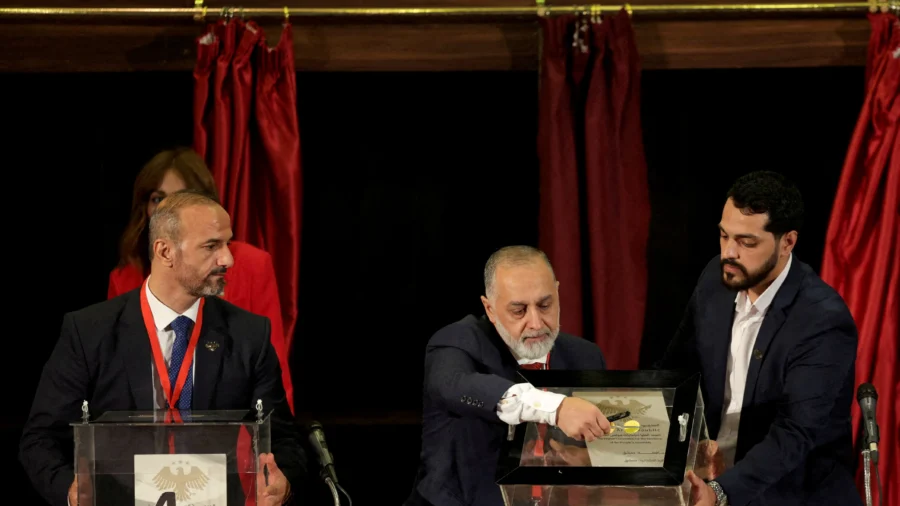
Elections in Syria saw few wins for women or ethnic and religious minorities, according to initial results of the country’s first post-Assad parliamentary poll.
“Among the most significant shortcomings of the electoral process were the unsatisfactory results for Syrian women’s representation,” Nawar Najma, a spokesman for Syria’s higher electoral committee, told reporters on Oct. 6.
“Christian representation was limited to two [parliamentary] seats, a weak representation relative to the number of Christians in Syria,” Najma said.
According to the electoral committee, 119 representatives have so far been selected for Syria’s 210-seat People’s Assembly.
Six of these representatives are women, while another 10 parliamentary seats went to ethnic and religious minorities, including two Christians.
Although results have yet to be finalized, preliminary numbers suggest that the incoming assembly will be overwhelmingly male and Sunni Muslim.
Held on Oct. 5, the parliamentary poll was Syria’s first election since the regime of former President Bashar al-Assad was ousted from power last December.
In January, Ahmed al-Sharaa was named Syria’s interim president. Al-Sharaa is the leader of Hayat Tahrir al-Sham (HTS), a Sunni Islamist group with previous ties to both al-Qaeda and ISIS terrorist groups, that spearheaded the offensive to topple the Assad regime.
Since assuming the presidency, al-Sharaa has pledged to protect Syria’s ethnic and religious minorities and promote democratic and inclusive governance.

The Biden administration retracted the counterterror bounty against al-Sharaa at the end of 2024.
Some critics have questioned the HTS leader’s commitment to democratic ideals, noting the highly centralized nature of the just-concluded parliamentary polls.
No Popular Vote
Incoming parliamentarians were not elected by popular vote. Rather, candidates were selected by electoral colleges, the members of which were chosen by regional councils set up by the higher electoral committee.The higher electoral committee, whose 11 members al-Sharaa appointed in June, was tasked with overseeing the entire polling process.
While women accounted for one-fifth of the electoral college’s membership, no quotas were set for female representation in the parliament itself.

Najma, the electoral committee spokesman, said al-Sharaa may use some of these appointments to augment female and minority representation in the assembly.
According to the government, a popular vote was rendered unfeasible by the lack of reliable demographic data and widespread displacement after years of conflict.
This means that the 21 assembly seats reserved for these areas, both of which remain outside the central government’s control, will stay vacant indefinitely.
Once final results are announced, they must first be endorsed by a presidential decree, after which the new People’s Assembly will convene its first session.
The incoming assembly will likely be tasked with passing legislation aimed at overhauling decades of state-controlled economic policy and ratifying treaties that could reshape Syria’s foreign relations.
The assembly will sit for a 30-month term, during which al-Sharaa’s government has pledged to prepare the ground for an eventual popular parliamentary vote.