


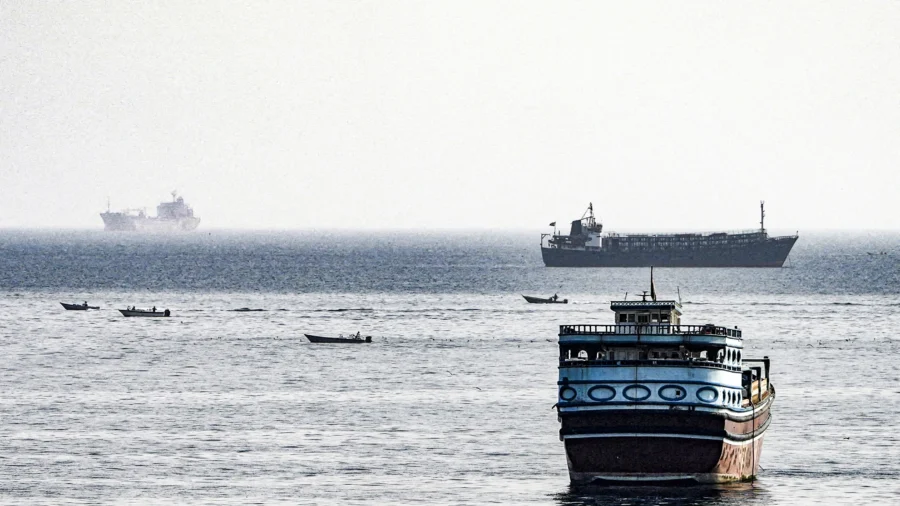
Iran warned on Aug. 10 that it would not reopen the Strait of Hormuz unless the United States agreed to a list of concessions, despite negotiations between Iran and Oman over a new maritime route entering the final stages.
“It is up to the U.S. side to stop and make amends for its illegal and destructive actions,” Iranian foreign ministry spokesman Esmail Baghaei said, referencing the U.S. military’s blockade of Iranian ports.
On Sunday, Iranian Foreign Minister Abbas Araghchi confirmed that an agreement on the establishment of a new maritime route in the Strait of Hormuz had entered the “final stages.”
However, Araghchi reiterated the regime’s position that the new shipping lanes would not be opened until the United States agreed to Tehran’s demands.
On Aug. 8, Iranian Supreme National Security Council Secretary Mohammad-Bagher Zolghadr said the United States would need to comply with multiple demands for the Strait of Hormuz to reopen.
The demands included the United States ending its war with Iran, removing the naval blockade, withdrawing military troops, lifting sanctions on the regime, releasing blocked Iranian assets, paying damages caused by the war, and avoiding future threats against Iran.
Over the weekend, Iran confirmed that it was continuing to negotiate with Oman to finalize a new maritime route in the Strait of Hormuz. However, Tehran warned that an agreement to establish the new route would not result in the reopening of the strait unless the United States agreed to its demands.
“Talks with Oman do not mean the Strait of Hormuz will be reopened,” Araghchi said on Aug. 9. “An agreement may be reached, but reopening the strait depends on other conditions conveyed through intermediaries.”
The Epoch Times reached out to the White House for comment but did not receive a response by publication time.
Trump addressed Iran’s demands in a Truth Social post on Monday.
“I see that Representatives of the Islamic Republic of Iran are asking for compensation for the damage done to them during the last five month Military Conflict (started because, THEY WILL NOT HAVE A NUCLEAR WEAPON), even though it was never mentioned in any of our negotiations or meetings!” he wrote.
In response to Tehran’s demands, Trump demanded compensation from Iran for all of the people killed and wounded by the regime’s roadside bombs and conflicts.
Trump added that the families of hundreds of thousands of innocent protesters killed by the regime over the past 50 years, including the 52,000 people he said were killed in the past five months, should receive compensation.
“I have instructed my representatives to put this firmly into any, and all, future negotiations,” Trump said.
On Aug. 9, U.S. Central Command (CENTCOM) said U.S. forces had redirected 55 commercial vessels, disabled two ships, and boarded two others to ensure compliance with the U.S. naval blockade against Iran’s ports.
The United States reinstated its naval blockade of Iranian ports on July 14 following the collapse of a memorandum of understanding between the two countries in early July. The blockade was reinstated after Iran fired at multiple commercial vessels in the Strait of Hormuz.
President Donald Trump told Axios on Aug. 9 that the United States was “low-keying” its approach to negotiating with Iran.
“We are only semi-negotiating with them,” he said. “We are just watching Iran with its huge inflation and the fact they have no money.”
Trump said Iran’s economy was in “very bad shape” due to the U.S. naval blockade and suggested that the regime lacked funding to pay for its military troops. He said negotiations with Iran were “like a chess game.”
“It will work out,” Trump said. “It always works out.”
The continued dispute over the control of the Strait of Hormuz comes as the Iran-backed Houthi terrorist group recently threatened to disrupt shipping in the Bab el-Mandeb Strait, a key strait in the Red Sea.
Yemen’s defense ministry confirmed that four military personnel and three civilians were killed on Sunday in a Houthi attack on Mokha, a Red Sea port town. The attack, which involved ballistic missiles and drones, injured 30 others, most of whom were civilians.
The attack by the Iran-aligned terrorist group in Yemen came after it imposed a maritime embargo on Saudi Arabia in July. The Houthis instituted a blockade against Saudi Arabian vessels in the Bab el-Mandeb Strait, a key waterway that connects the Red Sea to the Gulf of Aden and the Indian Ocean.