


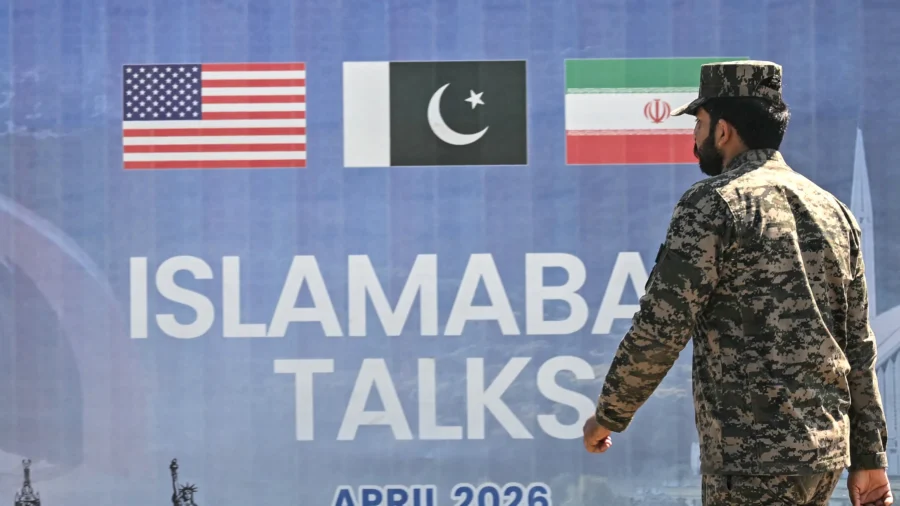
Iran signaled fresh uncertainty around U.S.-backed peace efforts on April 20, saying it has yet to decide whether it will attend a new round of talks in Pakistan, as Israeli officials warned that significant gaps remain and preparations are underway for a possible return to fighting.
Esmaeil Baghaei, spokesman for Iran’s Foreign Ministry, told reporters in Tehran that no decision has been made on participating in the next round of negotiations with Washington.
“As of now, as I am speaking to you, we have no plan for the next round of negotiations,” Baghaei said. “No decision has been taken in this regard.”
Iranian officials have repeatedly criticized Washington’s approach to diplomacy, saying that military pressure that runs alongside the push for a negotiated settlement has deepened mistrust. In a recent exchange with Pakistani officials, Iranian Foreign Minister Abbas Aragchi described U.S. actions—including threats against Iranian infrastructure and maritime activity—as evidence of bad faith and a lack of seriousness in talks, according to Iranian state-run media outlet Tasnim.
Trump also accused Iran of violating the ceasefire by firing at commercial vessels in the Strait of Hormuz, a vital global shipping route that has become a central flashpoint in the conflict. The strait, through which roughly a quarter of the world’s seaborne oil trade passes, according to the International Energy Agency, has been subject to Iranian restrictions and U.S. enforcement measures, contributing to ongoing tensions despite the pause in fighting.
Iran, in turn, has warned that any attacks on its infrastructure would be met with reciprocal strikes on U.S.-allied facilities in the region, raising the risk of broader escalation.
Baghaei said during Monday’s press briefing that Iran has “no enmity” with neighboring countries, while describing Tehran’s missile and drone strikes during the 40-day conflict as legitimate defensive actions against U.S. and Israeli military operations.
That characterization sharply contrasts with accounts from regional governments.
Israel Warns of Stalling Tactics
In Jerusalem, senior political and security officials said uncertainty over Iran’s participation in the next round of talks is compounding concerns that the ceasefire may not hold.Officials told Epoch Magazine Israel on April 20 that while the situation could shift quickly, Israel is preparing for the possibility that fighting will resume, citing what they described as “substantial difficulties” in the negotiations.
Israeli Prime Minister Benjamin Netanyahu held consultations with his inner cabinet on April 19 and is expected to convene the broader security cabinet as the situation evolves, according to the officials.
Israeli security sources assess that Iran may be deliberately prolonging negotiations, aiming to push talks into early May, when continued U.S. military action could require congressional authorization under U.S. law. Such a timeline, they told Epoch Magazine Israel, could complicate Washington’s ability to sustain pressure.
They also expressed concern over intelligence indicating that Iran’s Islamic Revolutionary Guard Corps is using the ceasefire window to recover ballistic missiles from underground storage facilities damaged in earlier U.S.-Israeli strikes. While entrances to some facilities were destroyed, officials believe intact missiles remain accessible and could be redeployed if hostilities resume.
On the nuclear front, Israeli officials said that the United States expressed willingness to discuss an agreement with Iran that would limit Tehran’s uranium enrichment for a period of 20 years—but the Iranians refused. From Israel’s perspective, they said, this is “highly problematic” because if Iran ultimately agrees to such a deal, then after Trump leaves office, Tehran might violate the agreement on the assumption that the next U.S. president will be reluctant to go to war again over that violation.
Further, Iran’s foreign minister said Monday that the transfer of Iran’s enriched uranium to another country was never subject to negotiations, describing the country’s nuclear achievements as a matter of national sovereignty and pride.
That position directly conflicts with Washington’s push to remove or neutralize Iran’s enriched uranium stockpile as part of any agreement.
The ceasefire is set to expire around April 22, with both sides signaling readiness to escalate if talks fail.