


A Chinese “wolf warrior” diplomat’s provocative statements have received criticism and protests from Japan and internationally.
On Monday, Japan criticised China’s consul general in Osaka, Xue Jian, who posted on X a veiled death threat after Prime Minister Sanae Takaichi suggested that Tokyo could become involved in military action if Taiwan were attacked by Beijing.
Minoru Kihara, Japan’s Chief Cabinet Secretary, told reporters on Monday that Xue’s statements were “extremely inappropriate.” He said Japan’s foreign ministry and the Japanese embassy in China had lodged a protest and asked for the post to be deleted.
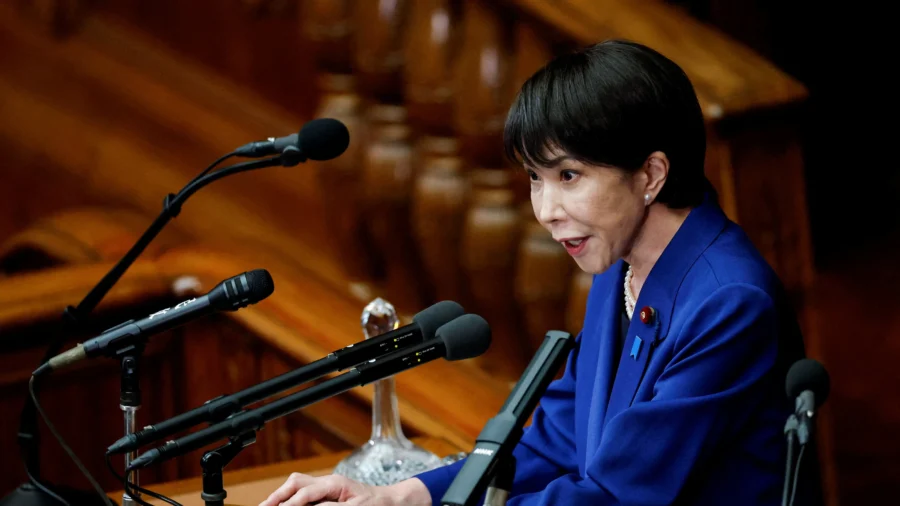
Xue’s threat targeted Takaichi’s remarks on Nov. 7, when she said that Chinese military action against Taiwan—such as a naval blockade involving warships and the “use of force”—could constitute a “survival-threatening situation” for Japan. Under Japanese law, such a situation could allow Japan to exercise “collective self-defence.”
In response, Xue shared a news article citing Takaichi’s comments on X on Saturday and commented, “cut off a dirty neck without a moment of hesitation, Are you ready for that?” followed by an angry-face emoji.
Xue’s post went viral in Japan, amassing multiple screenshots before he deleted it (likely by Sunday). Many in Japan, along with global political activists, called for declaring Xue persona non grata and expelling him from Japan.
Karen Kuo, spokesperson for the presidential office in Taiwan, said Taiwan “takes seriously the threatening remarks made by Chinese officials toward Japan. Such behavior clearly exceeds diplomatic etiquette,” Kuo said in a statement.
'A Taiwan Contingency Is a Japan Contingency'
Takaichi said her remarks were “hypothetical” in parliament on Monday, but she stood by her comments when asked to clarify her position.“Although I did state a number of possible scenarios, I also said the government will make a comprehensive judgment on whether the situation constitutes a ‘survival-threatening situation’ taking into account all information,” she said.
She clarified that Chinese ships merely encircling Taiwan would not be recognized as “a survival-threatening situation” for Japan, but if Beijing imposed a naval blockade amid fighting, that would constitute such a situation, prompting Japan to dispatch its Self-Defense Forces in support.
Beijing claims sovereignty over Taiwan, which it has never ruled. Taiwan’s democratically elected government firmly rejects this claim.
Unlike her predecessors, who tried not to mention Taiwan in public speeches to avoid confrontation with China, Takaichi—a close protégé and ideological heir to the late Shinzo Abe—echoed Abe-era rhetoric that “a Taiwan contingency is a Japan contingency.”
It’s not the first time Takaichi has irritated the Chinese Communist Party (CCP) within her first month in office. Two weeks ago, she angered Beijing by sharing a photo of her sidelines meeting with a Taiwanese representative at the Asia-Pacific Economic Cooperation summit in Seoul earlier this month.
U.S. President Donald Trump has said Xi told him he will not invade Taiwan while the Republican president is in office.
The United States stations 50,000 troops in Japan and 28,500 troops in South Korea. Last Tuesday, when U.S. War Secretary Pete Hegseth was asked at a press conference if U.S. troops in South Korea could be used against China in the Taiwan Strait, Hegseth said he would adopt “strategic flexibility” to pivot rapidly to hotspots.