


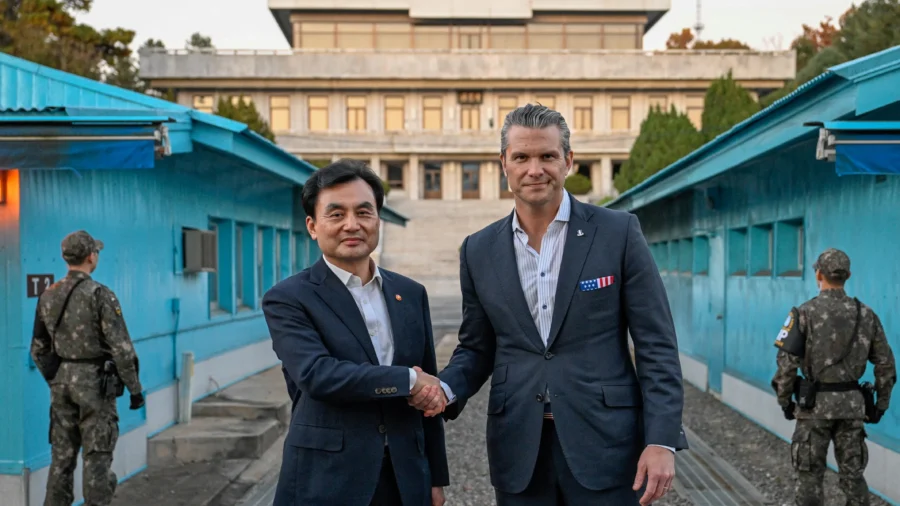
Although the United Forces in South Korea primarily aim to counter potential North Korean provocations, they will also adopt “strategic flexibility” to pivot rapidly to hotspots beyond the peninsula, U.S. Defense Secretary Pete Hegseth said on Tuesday.
When asked whether the 28,500 U.S. troops stationed in South Korea could be used against China in the Taiwan Strait, Hegseth signalled the importance of flexibility but said the alliance’s priority goal is to tackle nuclear-armed North Korea.
“There’s no doubt flexibility for regional contingencies is something we would take a look at, but we are focused on standing by our allies here and ensuring the threat of the DPRK is not a threat to the Republic of Korea, and certainly continue to extend nuclear deterrence as we have before.”
This comment echoes the defense ministers’ landmark visit to the Joint Security Area in the Demilitarized Zone on Monday—their first time in eight years.
Less than an hour before Hegseth arrived, Pyongyang fired ten multiple-launch rockets into the Yellow Sea—a timed reminder that the peninsula remains the world’s most heavily militarized border.
Calling South Korea a “model” ally, Hegseth said he was “greatly encouraged” by Seoul’s commitment to increase defense spending and to play a larger role in countering North Korean aggression.
In his Tuesday address to the National Assembly, President Lee Jae-myung urged lawmakers to approve an 8.2 percent defense hike for 2026, saying the funding will modernize the South Korean military’s weapons systems and reduce its reliance on the United States. South Korea now fields 450,000 troops.
“We face, as we both acknowledge, a dangerous security environment, but our alliance is stronger than ever,” Hegseth said.
The two defense chiefs agreed to several practical measures, including having U.S. warships repaired in South Korea—a move that Hegseth said will harness South Korea’s world-class shipbuilding capabilities and “ensure our most lethal capabilities remain ready to respond to any crisis.”
Hegseth explained that the president wants allies to be strong, “And because Korea has been a model ally, he’s open to opportunities like that—opportunities that ensure they have the best capabilities for their own defense and alongside us as allies.”
He also vowed to support the submarine programme across U.S. departments, "We're going to work closely with the Department of State and the Department of Energy to fulfill President Trump's commitment in a deliberate manner, and I think it's a reflection of something.”
South Korea possesses no nuclear weapons and remains under the United States' “nuclear umbrella” security commitment.
In recent years, the United States and South Korea have been establishing the Combined Nuclear and Conventional Integration system to fuse U.S. nuclear capabilities with South Korean conventional weapons across a full range of contingencies.
When asked whether Seoul might pursue its own nuclear weapons, Ahn Gyu-back denied the possibility and reaffirmed South Korea’s commitment to the Nuclear Non-Proliferation Treaty (NPT).
“South Korea is a party to the NPT, so it is not allowed to have nuclear weapons,” he said. “Therefore, developing nuclear weapons in South Korea would not be possible.”