


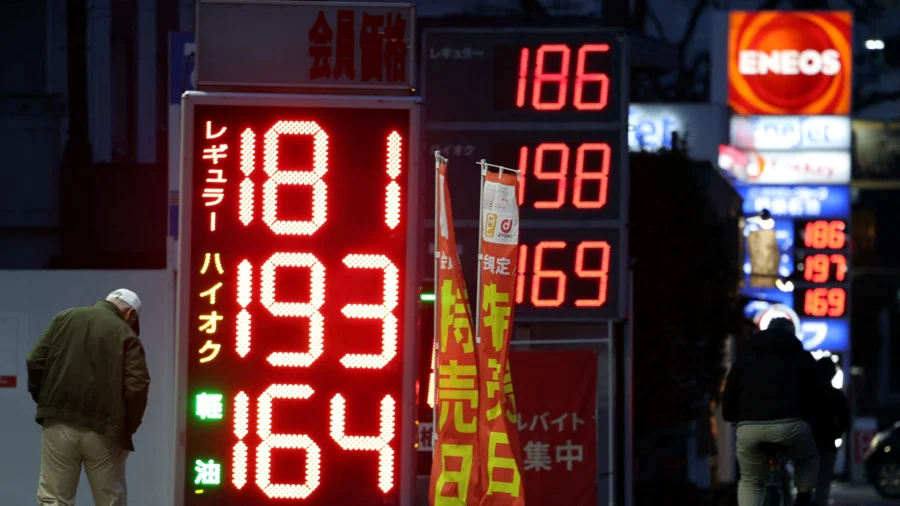
Japan has begun releasing emergency oil reserves after the Iran War disrupted energy flows through the Middle East and triggered a surge in global crude prices.
It will start releasing 15 days’ worth of private-sector oil on March 16 and a month’s worth from the state reserves from late this month, according to the country’s Ministry of Economy, Trade and Industry (METI).
Yuriy Humber, CEO of Tokyo-based consultancy Yuri Group, said the reserves can help stabilize supplies and prices in the short term, but “they mainly buy time.”
“They can’t fully offset a prolonged disruption in the Strait of Hormuz,” he said.
Japanese Prime Minister Sanae Takaichi last week announced plans to release 80 million barrels of oil from national stockpiles, the largest drawdown in the country’s history.
On March 16, Brent crude futures were up 16 cents to $103.30 a barrel, while U.S. West Texas Intermediate crude was down $1.50, or 1.5 percent, to $97.21.
Tokyo said the release would amount to roughly 45 days of supply for the nation, which relies heavily on imported energy. The government has asked Japan’s refiners to process the released crude to help stabilize domestic supply. Officials said the measure will reduce the country’s national oil reserves by about 17 percent.
Since the United States and Israel launched their Feb. 28 strikes on Iran, shipping traffic through the Strait of Hormuz—which runs close to Iran’s coastline—has slowed to a near standstill.
The Japanese government, which is an import-dependent economy, said the release is intended to cushion the domestic economy from supply shocks while helping stabilize global markets.
It has been discussing the situation with the International Energy Agency (IEA), which coordinates strategic petroleum reserves among major industrialized economies and previously oversaw emergency releases during major supply disruptions, including the 1991 Gulf War and Russia’s invasion of Ukraine.
METI Minister Ryosei Akazawa held an online meeting on March 9 with H.E. Dr. Fatih Birol, executive director of the IEA, “to exchange views on the situation in the Middle East concerning Iran,” METI said in a statement.
“Minister Akazawa expressed his expectation for the IEA’s continued leadership in stabilizing the international energy market,” the ministry added.
Oil remains the most significant energy source in Japan, accounting for about 40 percent of the country’s total energy supply, according to the IEA.
It said that Japan has no notable domestic production and is heavily dependent on crude oil imports, with between 80 and 90 percent coming from the Middle East.
Each country will release emergency stockpiles over time, with some taking additional steps to curb surging global energy prices.