


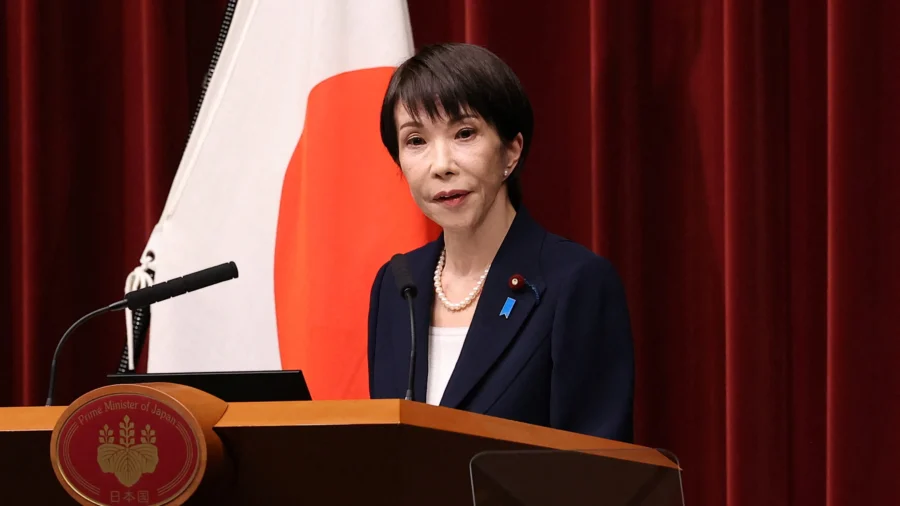
Japan will temporarily ease restrictions on coal-fired power plants and may increase nuclear output in the fiscal year 2026 to safeguard energy supplies, Japanese Prime Minister Sanae Takaichi said on March 27.
The measures are part of a broader effort by Tokyo to reduce reliance on liquefied natural gas (LNG) and strengthen national energy security, amid the ongoing Iran war and the effective closure of the Strait of Hormuz.
LNG accounts for roughly 30 percent of Japan’s electricity supply, far exceeding oil-fired generation at about 7 percent, Takaichi said in a March 27 post on X.
LNG imports via the Strait of Hormuz account for about 6 percent of Japan’s total supply, or roughly 4 million tons, Takaichi added. She said that Japanese utilities’ inventories are currently close to that level, and that alternative procurement is progressing.
“For this reason, there is currently no disruption to the stable supply of electricity, but to ensure even greater preparedness, we will increase the operation of coal-fired power plants and conserve LNG usage,” she said.
In 2024, Japan’s coal-fired electricity generation totaled 295,322 gigawatt-hours, according to IEA data.
Nuclear Energy
Takaichi has previously said that nuclear power is essential for Japan’ economic stability.Last month, Japan restarted Unit 6 of its largest nuclear power plant, the Kashiwazaki-Kariwa Nuclear Power Station.
According to the U.S. Energy Information Administration (EIA), nuclear output is expected to replace natural gas, which accounted for 33 percent of Japan’s electricity in 2024.

Emergency Releases
Takaichi said that Japan is also coordinating with G7 countries and the International Energy Agency (IEA) to ensure stable fuel supplies.“In the future, we will sequentially release a total of approximately 8.5 million KL (about a one-month supply) from 11 domestic bases, ensuring the utmost preparedness for stable domestic energy supply,” Takaichi said on March 27.
She added that even if the Iran conflict lasts longer, the Japanese government will keep adjusting its support to ensure people’s daily lives are not disrupted.
Alongside energy measures, the Japanese government is introducing support for businesses affected by rising fuel costs.
Takaichi said in a March 27 post on X that the government would implement interest rate reductions on safety-net loans from the Japan Finance Corporation and expand eligibility criteria starting April 1 to include disruptions linked to the Middle East situation.
About 1,000 consultation centers had been set up nationwide since March 23, offering various support services for small and medium-sized affected by the Middle East conflict.
Authorities have also urged companies and institutions to reflect higher energy and raw material costs in transaction pricing.