


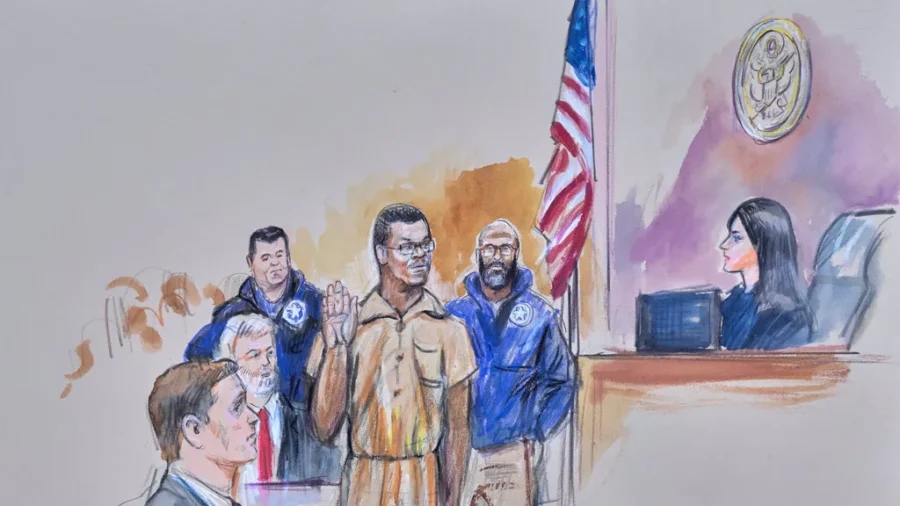
A magistrate judge has rejected a request by Brian Cole Jr., the man suspected of placing pipe bombs in Washington before the events of Jan. 6, 2021, to stay with his grandmother before an anticipated trial.
Cole has been detained at the Rappahannock Regional Jail since December and indicated he would be willing to undergo house arrest, wear an ankle monitor, and comply with other conditions of release.
But on Jan. 2, U.S. Magistrate Judge Matthew Sharbaugh said the evidence pointed to him posing too great a danger to the community.
"The government has shown by clear and convincing evidence that there are no conditions of release that can reasonably assure the safety of the community," Sharbaugh said.
During the hearing on Dec. 30, defense attorney Mario Williams attempted to downplay the threat that Cole posed, emphasizing that he had no criminal record and followed the same routine every day.
While Sharbaugh said Cole's record and other factors weighed in his favor, the judge said Cole's alleged behavior demonstrated "a startling and significant capacity for dangerousness."
Cole faces the prospect of decades in prison for violating laws relating to the transportation and attempted use of an explosive device.
Speaking from the bench on Dec. 30, Sharbaugh said a grand jury had returned an indictment against Cole in the Superior Court of D.C. instead of the federal district court where Sharbaugh sits.
Due to ongoing legal disputes about the use of such indictments, the judge deferred a decision on whether to accept it.
In a separate order on Jan. 2, Sharbaugh said he would accept the indictment while prosecutors sought another indictment from a federal grand jury.
According to a docket note, prosecutors sought an indictment in the superior court because no federal grand jury was in session at the time.
"The government also represents that it will promptly seek a superseding indictment from a federal grand jury panel as soon as those panels reconvene," a note signed by Sharbaugh read.
He added that "the court finds significant the government's confirmation that it does not intend to use the Superior Court grand jury as an ultimate end-run around a federal grand jury empaneled by this court."
According to the Justice Department, Cole said after his arrest last month that he didn't intend for the bombs to impact the election certification in Congress on Jan. 6. He also said he was relieved when the bombs didn't detonate.
Sharbaugh, however, drew attention to the potential impact if they did explode.
In his Jan. 2 opinion, he said that "if the plan had succeeded, the results could have been devastating: creating a greater sense of terror on the eve of a high-security Congressional proceeding, causing serious property damager in the heart of Washington, D.C., grievously injuring [Democratic National Committee] or [Republican National Committee] staff and other innocent bystanders, or worse."
Sharbaugh acknowledged that there is typically a legal presumption that a person should not be detained before trial, but said that several factors indicated he still posed a danger.
Echoing prosecutors' arguments, Sharbaugh pointed to evidence that Cole had purchased materials that could be used to make a bomb, as well as evidence that he wiped data from his phone nearly 1,000 times since 2021.
Williams had suggested on Dec. 30 that those deletions should be viewed in light of Cole's obsessive compulsive disorder, which the defense reported in a filing that day.
Cole has also been diagnosed with autism spectrum disorder (OCD), level 1.
Those diagnoses would usually caution against pre-trial detention, Sharbaugh said.
Although the data deletion could have stemmed from OCD, Sharbaugh said that "Cole's alleged behavior is at least equally suggestive of efforts to conceal and destroy information about his personal communications and online activity."
"This is troubling," he added, "and portends real challenges in monitoring his conduct in a home-detention setting."