


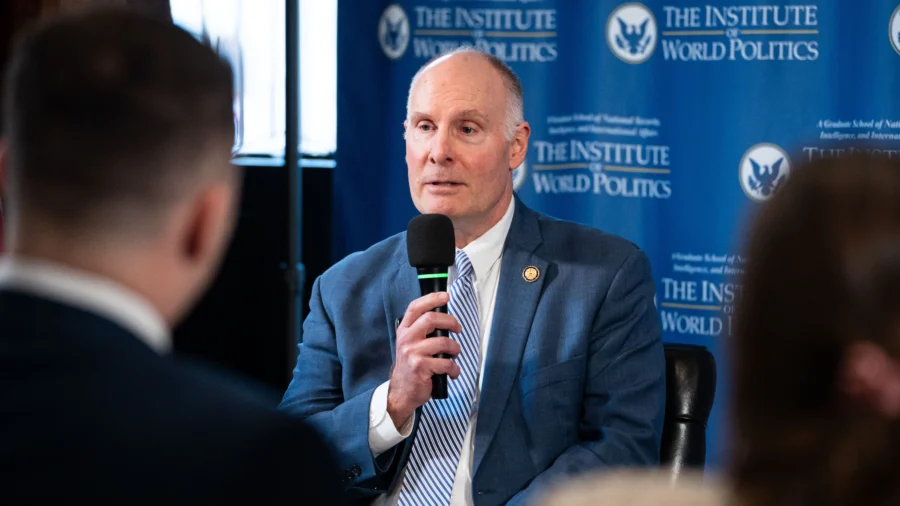
House Select Committee on the Chinese Communist Party (CCP) Chair Rep. John Moolenaar (R-Mich.) said that the CCP is to blame for the United States’ recent decision to revoke visas for international students from China.
Moolenaar said the Chinese communist regime manipulates and pressures overseas students into participating in the CCP’s espionage against its self-declared enemy, the United States.
He spoke ahead of the Shangri-La Dialogue defense summit in Singapore and urged caution in business and strategic dealings with China so long as the regime continues its path of aggression against freedom.
“I think the end goal is to have a relationship with China that acknowledges the reality that their government is moving in a very different direction than they promised, and we have to reset that relationship,” he said.
“If China were to change course and promote actual peace and be responsible in the world stage, then I think that would be healthy for the whole world. But if they continue down this path … when you look at their close allies—at Russia, North Korea, Iran, and the partnerships that they’re forming—that is a threat to the entire free world.”
The decision came amid a public spat between Harvard University and the Trump administration, which had requested information about international students over concerns including anti-Semitism. Harvard’s refusal led to the administration pulling funding, and then revoking the university’s international student program, which was reinstated as the university sued.
“Vetting is not a one-time process; it’s continuing,” department spokeswoman Tammy Bruce said.
According to the State Department, the Chinese regime monitors Chinese students, mobilizing them through student associations.
Some Chinese Students and Scholars Association branches in the United States have openly admitted that they are directed, supported, or financed by Chinese consulates. These students have been known to attempt to force the cancellation of events or speeches hosted by overseas dissident groups at U.S. schools.
The FBI warns on its website that the CCP uses its post-graduate students and postdoctoral researchers in fields such as engineering, science, and mathematics to “operate as non-traditional collectors of intellectual property.”
Along with lawmakers chairing the Education and Workforce Committee and House Republican Conference, he requested documents and answers over Harvard’s training of Xinjiang Production and Construction Corps (XPCC) personnel even after the group was sanctioned in 2020 for “serious rights abuses against ethnic minorities.”