


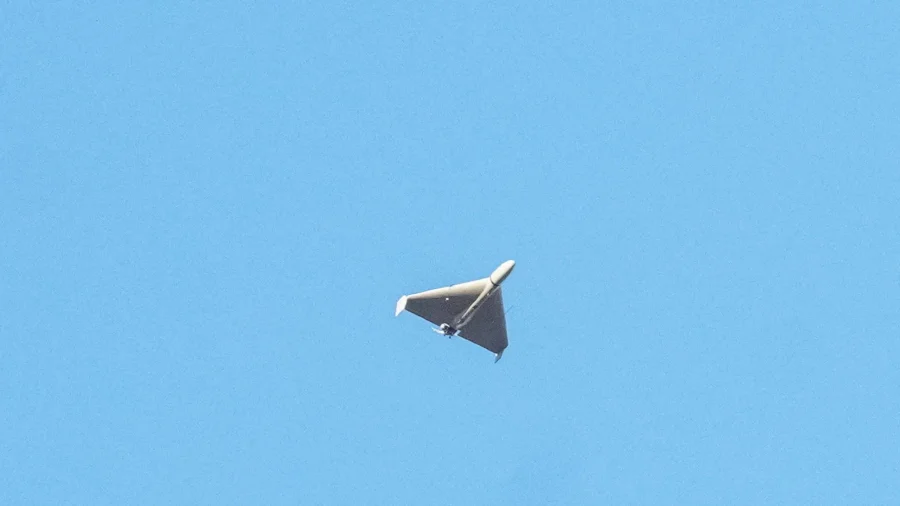
Lithuania’s parliament on Sept. 23 passed legislation authorizing the NATO-aligned country’s military to shoot down drones that illegally enter its airspace.
“Now we can quickly react in any way, including the destruction of drones,” Defense Minister Dovile Sakaliene said.
Previously, Lithuania’s military could only target incoming drones if they were found to be armed or posed an imminent threat to the state.
“Our laws and procedures were not adapted to current threats,” Sakaliene said. “We can now react at the speed of lightning.”
The move follows recent high-profile incidents in which Russian military aircraft violated the airspace of Eastern European NATO allies.
On Sept. 9 and Sept. 10, NATO member Poland shot down more than 20 unidentified drones that had flown over its eastern border from neighboring Belarus.
Warsaw and other Western capitals say the aerial incursion was a deliberate provocation by Russia—an accusation Moscow denies.
Following the incident, NATO launched a major air operation—dubbed “Eastern Sentry”—with the stated aim of defending its eastern flank.
As part of the operation, British fighter jets are now flying sorties over Poland, sending a signal to Russia that “NATO airspace will be defended,” the United Kingdom’s Defense Minister John Healey has said.
This week, Warsaw also issued a warning that its military would shoot down any aircraft that entered its airspace without permission.
“We will take the decision to shoot down flying objects when they violate our territory,” Polish Prime Minister Donald Tusk told reporters.
In a similar incident on Sept. 19, NATO member Estonia said three Russian fighter jets briefly entered its airspace before being forced to withdraw by NATO aircraft.
Despite the Russian denials, NATO has said that Moscow “bears full responsibility for these actions, which are escalatory, risk miscalculation, and endanger lives.”
“NATO and Allies will employ … all necessary military and non-military tools to defend ourselves and deter all threats from all directions,” the alliance’s North Atlantic Council said in a statement issued on Sept. 23.
On the same day, NATO member Norway claimed Russian aircraft had briefly violated its airspace—on three separate occasions—earlier this year.
“This is not acceptable and we have made that clear to Russian authorities,” Norwegian Prime Minister Jonas Gahr Stoere said.

Vilnius Calls For ‘Drone Wall’
Last month, Lithuania asked NATO to help bolster its air defenses after two drones entered its airspace in July—from Belarus—and crashed on its territory.“This must not be only Lithuania’s responsibility, because we are defending the eastern NATO flank,” Lithuanian Foreign Minister Kestutis Budrys said at the time.
According to Lithuania’s defense ministry, the drones were likely fired by Russia at targets in Ukraine but were knocked off course by Ukrainian air defenses.
On Sept. 22, Budrys said Ukraine should play a role in building a planned “drone wall” across Eastern Europe, given Kyiv’s skill and experience in drone warfare.
Brussels is now mulling means of erecting a drone-enforced barrier along the European Union’s eastern border—especially after the recent drone incursion into Poland.
“We have big holes in our EU defense,” Budrys told Reuters.
“We lack the right equipment that would allow us to detect drones … and then to destroy them,” he added.
“We have to bring this technology to the frontline … so that it will be effective together with the Ukrainians,” Budrys said.