


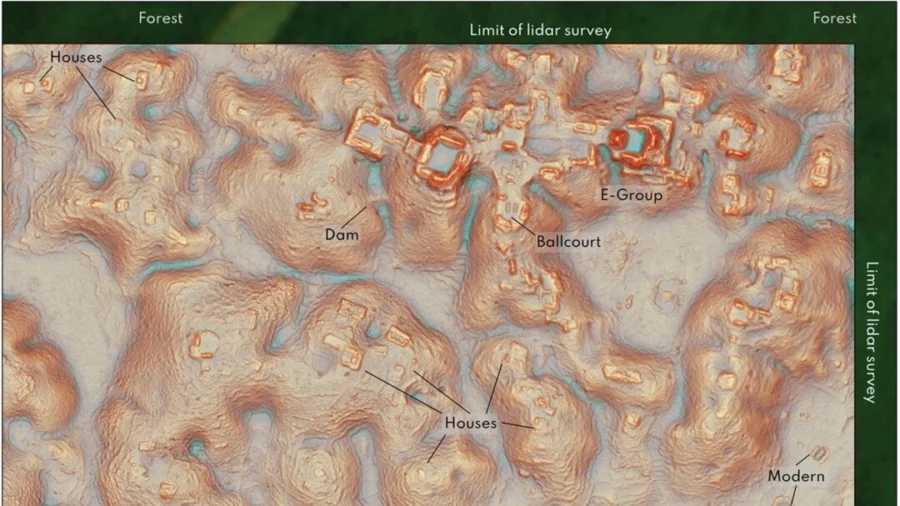
While scanning samples of laser-mapped areas of the central Maya Lowlands, researchers discovered a large Mayan city, comprised of pyramids, plazas, and a water reservoir, hidden deep in the Mexican jungle. The discovery serves as confirmation that ancient civilization was widespread.
Tulane University doctoral student Luke Auld-Thomas and his advisor, Professor Marcello Canuto, found some 6,700 structures in a jungle near Campeche, Mexico, including a large city dating back nearly 1,500 years ago.
The city was named Valeriana.
Previously lost cities were stumbled upon by boots-on-the-ground archeologists, wading through dense and remote forests.
Recently, archeologists have been using Light Detection and Ranging (LiDAR) to map jungle areas, an aerial 3D mapping technique capable of scanning the surface underneath thick forest canopies.
Though highly efficient at detecting man-made surface structures, LiDAR remains expensive. Given that scientists have only examined areas expected to contain ancient ruins, questions arose regarding what extent this highly targeted mapping produces a distorted view of how dense and widespread ancient civilizations were.
Rather than look for fundraisers, Auld-Thomas decided to review LiDAR data collected over a decade ago, for completely unrelated purposes, by Mexican firm CartoData.
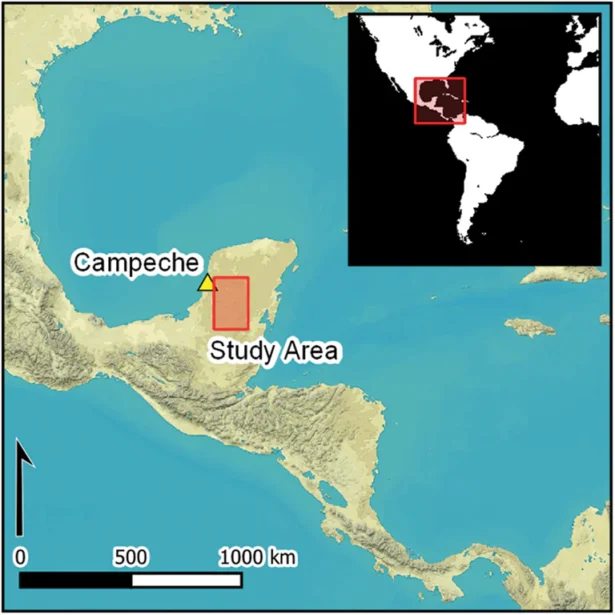
This gave Auld-Thomas and his team detailed topographic maps of 3 patches of land totaling 64 square kilometers, and three strips of land, 275 meters wide each and 213 kilometers long in total—another 58 square kilometers.
And sure enough, they found more than just a lost city; in fact, the dense jungle of Campeche was once a relatively densely populated and extensively engineered landscape.
“We can only conclude that cities and dense settlement are simply ubiquitous across large swaths of the central Maya Lowlands,” the research team concluded in the study.
According to the team, previous on-site validation proved that the number of buildings identified through LiDAR data, is largely correct.
“It allows us to tell better stories of the ancient Maya people.”