


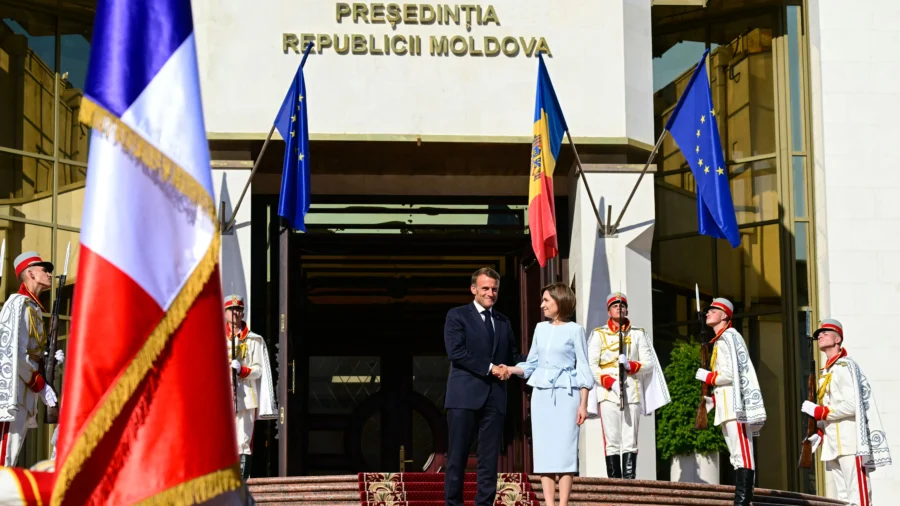
French President Emmanuel Macron, German Chancellor Friedrich Merz, and Polish Prime Minister Donald Tusk pledged their support for Moldova joining the European Union during a visit to the country on Aug. 27.
The three European leaders met with Moldovan President Maia Sandu in the capital, Chisinau, on the day the former Soviet republic marked its independence from the USSR.
Sandu’s pro-EU allies face a challenge in a parliamentary election slated to take place in September.
Russia has denied meddling in Moldovan politics.
“Our country was baselessly accused of interfering in Moldova’s internal affairs and attempting to sway the will of the Republic’s citizens,” Russian Foreign Ministry spokeswoman Maria Zakharova said in October last year, following the first round of presidential elections and the constitutional referendum in Moldova.
Russia has troops stationed in the largely Russian-speaking region of Transnistria, which broke away from Chisinau’s control in a brief war in the early 1990s. The majority of the Moldovan population, which totals around 2.5 million, speaks Romanian.
“And let me say this clearly: There is no alternative to Europe. Without the European Union, Moldova will remain trapped in the past.”
Sandu said Moldova’s independence, sovereignty, and peace are being tested more than ever.
“Interference in our elections, illegal financing from abroad, disinformation campaigns, cyber-attacks, paid protests, the use of the church and online platforms for anti-European messages, attempts to sabotage the diaspora vote, efforts to sow hatred between communities,” she said.
Macron said during the news conference that Moldovan citizens have seen that joining the EU represents an opportunity in terms of prosperity, security, and modernization. France will continue to provide support to Moldova during the next steps of its path toward accession, he added.
Merz said Germany, France, and Poland stand with Moldova, which he said is under “constant hybrid attacks” from Moscow.

The leaders also reaffirmed their support for Ukraine in its war against Russia.
Moldova applied to join the EU at the same time as Ukraine, just days after Russia launched its 2022 invasion.
In the October 2024 referendum, Moldovans narrowly voted to pursue integration into the 27-nation bloc.
Following the referendum, Moscow accused the West of “blatant interference” in Moldova’s electoral process.
“The culmination of the extensive anti-Russian campaign initiated by Chisinau was the decision to open, under a pretext, only two polling stations in Russia, where, according to various estimates, between 300,000 and 500,000 Moldovan citizens reside,” Zakharova said. “In contrast, approximately two hundred polling stations were established in the United States and Western Europe.”
In July, PSRM announced an electoral alliance with other pro-Moscow parties, the Heart of Moldova, the Future of Moldova, and the Communist Party to “put an end to foreign interests and NATO,” in the words of PSRM leader and former President Igor Dodon.